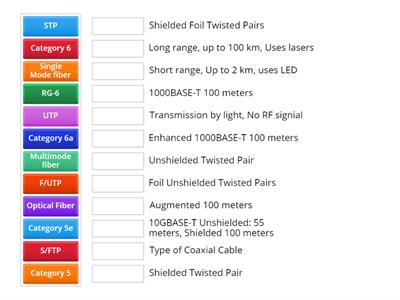
single mode, Used for long-distance transmissions, single mode fibers have a smaller core and support higher bandwidth with less signal attenuation., Multi mode, Suitable for shorter distances, multimode fibers have a larger core, which allows multiple light modes but can cause more signal dispersion and attenuation over longer distances., Category 5/6/7/8, Using a lower category cable (e.g., Cat5) instead of a higher category (e.g., Cat6, Cat7, or Cat8) can limit data transfer speeds and lead to increased errors, Shielded twisted pair (STP) vs Unshielded twisted pair (UTP), Using UTP cables in environments with high electromagnetic interference (EMI) instead of STP can result in signal degradation on and data corruption., Signal degradation, signal diminishes over distance or due to interference, crosstalk, specific type of signal degradation where a signal transmitted on one cable or channel interferes with a signal on another cable or channel., interference, disruption of signal transmission caused by electromagnetic signals from other electronic devices or cables., Attenuation, gradual loss of signal strength as it travels through a cable or medium., Improper termination, occurs when network cables are not correctly terminated with the appropriate connectors or techniques., Transmitter (tx)/receiver (rx) transposed, happens when the transmitter and receiver wires are incorrectly connected, causing communication failures., Increasing interface counters, Interface counters track various metrics related to network traffic and errors. Increasing counters indicate potential issues that need to be addressed to maintain optimal network performance, Cyclic redundancy check (CRC), occur when there is a mismatch in the data checksum, indicating data corruption during transmission., Runts, packets that are smaller than the minimum allowed size (usually less than 64 bytes)., Giants, packets that exceed the maximum allowed size (usually greater than 1518 bytes for Ethernet frames)., Drops, occur when packets are discarded due to congestion, bu er overflow, or configuration issues.
0%
5.2 Troubleshoot cabling/interface
Compartir
Compartir
per en/la
Gprimal
Network plus
N10-009
Comptia
Editar continguts
Guarda
M'agrada
Imprimir
Incrustar
Més
Assignacions
Tauler de classificació
Mostrar-ne més
Mostrar-ne menys
Aquesta taula de classificació és privada actualment. Fés clic a
Compartir
per fer-la públic.
El propietari del recurs ha inhabilitat aquesta taula de classificació.
Aquesta taula de classificació està inhabilitada perquè que les teves opcions són diferents a les del propietari del recurs.
Reverteix les opcions
Emparellar
és una plantilla de final obert. No genera puntuacions per a una taula de classificació.
Cal iniciar la sessió
Estil visual
Tipus de lletra
Subscripció obligatòria
Opcions
Més aviat així
Network+ Obj 2.1 Cross-over and Straight-through Cables
per en/la
Kberg46
Endreç del grup
20
Network+ Obj 2.1 Cable Standards
per en/la
Kberg46
Emparellar
17
Network+ Obj 5.3 Troubleshooting Issues
per en/la
Kberg46
Emparellar
31
Network cables
per en/la
Mhayesgw
Emparellar
30
Kiwi's Copy of Ethenet / Coaxial Cable and Fiber Standards Comptia A+ 1101
per en/la
Kiwimynted
Emparellar
84
CompTIA 1101 USB Speeds
per en/la
Deptmagic
Emparellar
16
Comptia A+ 1101 3.1 Network Cables
per en/la
Rivera9898
Emparellar
30
Network+ N10-008 - Routing Technologies 2.2
per en/la
I3igwolf
Emparellar
13
Canvia de fonament
Mostrar-ho tot
Resultats oberts
Copiar enllaç
Codi QR
Suprimir
Restaurar desada automàtica:
?