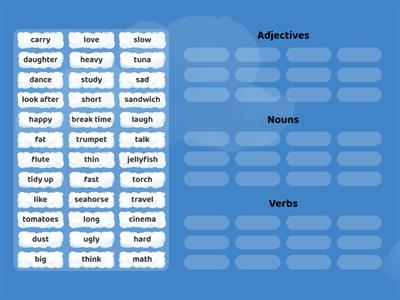
Verb, A word that shows action (Ex: run, swim, is), Pronoun, A word that takes the place of a noun. (Ex: he, she, they, it), Adjective, A word that describes a noun. (Ex: crunchy, green, loud), Adverb, Describes a verb, adjective, or adverb. (Ex: quickly, very, now), Preposition, Shows the relationship or position of a noun. (Ex: under, on, after), Conjunction, A word that joins words or phrases together. (Ex: and, but, or, so), Noun, A person, place, thing, or idea. (Ex: pizza, library, teacher), Past Simple, Shows an action that already happened. (Ex: I walked to school.), Present Simple, Shows an action that happens regularly or is true. (Ex: I walk to school.), Future Simple, Shows an action that will happen later. (Ex: I will walk to school.), Complete Sentence, Has a subject, a verb, and a complete thought., Fragment, An incomplete sentence missing a subject or a verb., Run-on Sentence, Two sentences smooshed together without a comma or conjunction., Subject-Verb Agreement, The subject and verb must match (singular vs. plural)., Transition Word, Words like however, therefore, and finally that connect ideas., Capitalization, Using big letters for names, places, and the start of sentences., Punctuation, Using marks like commas, periods, and quotation marks correctly., Coordinating Conjunction, FANBOYS (for, and, nor, but, or, yet, so) used with a comma., Comparative Adjective, Compares two things, usually ends in -er. (Ex: faster), Superlative Adjective, Compares three or more things, usually ends in -est. (Ex: fastest), Possessive Noun, Shows ownership using an apostrophe. (Ex: the boy**'s** ball)
0%
Grammar
Compartir
Compartir
per en/la
Fredy31
Editar continguts
Guarda
M'agrada
Imprimir
Incrustar
Més
Assignacions
Tauler de classificació
Mostrar-ne més
Mostrar-ne menys
Aquesta taula de classificació és privada actualment. Fés clic a
Compartir
per fer-la públic.
El propietari del recurs ha inhabilitat aquesta taula de classificació.
Aquesta taula de classificació està inhabilitada perquè que les teves opcions són diferents a les del propietari del recurs.
Reverteix les opcions
Esclat de globus
és una plantilla de final obert. No genera puntuacions per a una taula de classificació.
Cal iniciar la sessió
Estil visual
Tipus de lletra
Subscripció obligatòria
Opcions
Més aviat així
Noun, Verb, Adjective, Adverb
per en/la
Rhyshiggins
Emparellar
42
Nouns, Adjectives, Verbs
per en/la
Lucy18
Endreç del grup
11
Verbs, nouns & adjectives
per en/la
Fionasparrow
Cartes aleatòries
26
Verb, Adjective, Noun, Adverb
per en/la
Monicajun
Qüestionari
68
Nouns, Adjectives, Verbs.
per en/la
Cquinonez
Endreç del grup
8
Nouns, Verbs, Pronouns, Adjectives
per en/la
Lmule
Endreç del grup
10
Adjectives, Nouns and Verbs
per en/la
Tecnologia7
Endreç del grup
8
Adjectives, Nouns, Adverbs, Verbs
per en/la
Lbritos
Endreç del grup
10
Canvia de fonament
Mostrar-ho tot
Resultats oberts
Copiar enllaç
Codi QR
Suprimir
Restaurar desada automàtica:
?