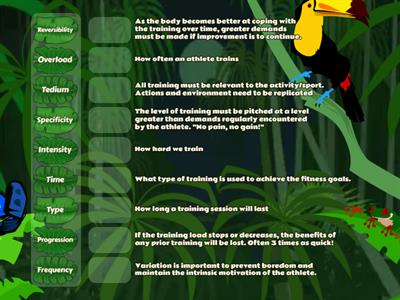
Specificity, Training must be relevant to the individual and their sport. This can be achieved by tailoring training specitically for the sport or even the position that the individual plays, the muscle groups that they use the most or the dominant energy system of the athlete. For example, a 100m sprinter is likely to train very differently to a 10km racer despite them both being track athletes, Progressive Overload, Training frequency, intensity and time (FITT) must be increased over the training period to ensure that the body is bushed beyond its normal rhythm. tncreases must be gradual so that the athlete avoids a plateau in performance or worse, injury, Intensity, Is increased by lifting a greater resistance, such as with weight training, or by training at a higher percentage of maximum heart rate. This can be done either as continuous or interval training., Duration, The length of time that a session or a period of work takes to complete. This could also be referred to as "time". Different training methods require different manipulations in time. For example continuous training should involve a bout of at least 20 minutes whereas plyometrics would be shorter sharper efforts., Frequency, The number of session completed or how often training is undertaken. Each style of training requires a different number of sessions over a training program period in order to see best results. This will be determined by adequate rest also in order to allow the body to recover and adapt., Reversibility, Systems reverse or de-adapt if training stops or is significantly reduced or injury prevents training from taking place. It is essential to avoid breaks in training and to maintain the motivation of the athlete, Overtraining, If an athlete does not have sufficient rest periods then they are at risk of overtraining. This is when the body does not have time to adapt to the training and as a result the fitness of the athlete declines and they are more at risk of becoming ill or injured, Diminishing Returns, When unfit athletes begin a training regimen, their fitness improves rapidly, byt as they become fitter, the amount of improvement lessens as they approach their genetic limits
0%
Training Principles
Share
Share
by
Sarahmayo
Y10
Physical Education
I-edit ang Content
Save
Like
I-Print kini
Embed
Uban pa
Assignments
Leaderboard
Show more
Show less
Kini nga leaderboard naka-pribado. Pag-klik sa
Share
aron himuon kini nga publiko.
Kini nga leaderboard gi-disable sa tag-iya sa resource.
Kini nga leaderboard gi-disable tungod ang imong mga kapilian lahi ra sa tag-iya sa resource.
I-revert ang mga Kapilian
Ang
Match up
usa ka open-ended nga template. Dili kini makamugna ug mga marka sa leaderboard.
Kinahanglan mag log in
Visual style
Fonts
Subscription required
Mga Option
More like this
1.1.4 principles of training
by
Lukec1
Match up
7
Training Principles
by
Brookesj
Match up
16
Principles of training
by
Jameshood
Quiz
8
PRINCÍPIOS DE TREINAMENTO ESPORTIVO
by
Terciagomes
Wordsearch
3
Principles of Training OR FITT Principles
by
Gamemp8
Group sort
2
PRINCÍPIOS DO TREINAMENTO FÍSICO
by
Alessandracalde1
Match up
2
TRAINING AND ITS EFFECTS
by
Moesvg6macmillan
Wordsearch
1
Training Methods Advantages & Disadvantages: Altitude, Circuit, Plyometric & Weight Training
by
Tomlinscotepedept21
Group sort
3
I-switch ang template
Ipakita tanan
Open results
Copy link
QR code
Mag-delete
I-restore ang gi-autosave:
?