Awareness Training, Client identify when problem behavior is about to start., Competing Response, Incompatible with the habit and makes occurrence nearly impossible or difficult., Relaxation Techniques, 1) Diaphragmatic Breathing 2) Progressive muscle relaxation 3) Attention focused exercises, DRA, Reinforce the desired behavior and do not reinforce undesirable behavior., DRO, Strategy when delivering a reinforcer contingent on the absence of undesirable behavior for some period., Differential Reinforcement, Attempt to get rid of undesirable or problem behaviors by using positive reinforcement of desirable behaviors., Token, Something that represents desired reinforcers and take that “something” and cashes it in later for these reinforcers., DRI, Reinforce behaviors that make the undesirable or problem behavior impossible to make., DRL, Don’t necessarily want to completely stop a behavior, or take it to extinction, but reduce the occurrence of a behavior., NCE, Are not linked to any specific behaviors being completed., Positive Practice, Engaging in correct form of behavior over and over again., Restitution, Restoring environment to a condition better than wit was before undesirable behavior., Response Costs, A type of negative punisher in which some amount of reinforcer is removed when undesirable or problem behaviors occurs., Exclusionary, Person is removed from actual location problem occurring., Time-out, When a person os removed from activity because of undesirable or problem behavior., Non-exclusionary, Not removed from location but cannot partake in reinforcing activity., Habit Behaviors, Nervous, Tics, Stuttering, Blaming, Focus on someone else as a source of negative feelings., Mind Reading, Assuming others know what you are thinking., Regret Orientation, Focusing on past. What you could have done better., Dichotomous Thinking, All or Nothing terms, Flooding, Exposing the person to the maximum level of stimulus and as nothing aversive occurs, fear should break, leaving the person unafraid., Overgeneralization, Larger patterns of negative events, Inability to Disconfirm, Ignoring evidence that contradicts your cognition., Personalizing, Blaming self for negative events
0%
Study Guide 2
Teilen
Teilen
von
Breon88fonville
Inhalt bearbeiten
Speichern
Gefällt mir
Drucken
Einbetten
Mehr
Zuweisungen
Bestenliste
Mehr anzeigen
Weniger anzeigen
Diese Bestenliste ist derzeit privat. Klicke auf
Teilen
um sie öffentlich zu machen.
Diese Bestenliste wurde vom Eigentümer der Ressource deaktiviert.
Diese Bestenliste ist deaktiviert, da sich Ihre Einstellungen von denen des Eigentümer der Ressource unterscheiden.
Einstellungen zurücksetzen
It's a Match
ist eine Vorlage mit offenem Ende. Es generiert keine Punkte für eine Bestenliste.
Anmelden erforderlich
Visueller Stil
Schriftarten
Abonnement erforderlich
Einstellungen
Eher so
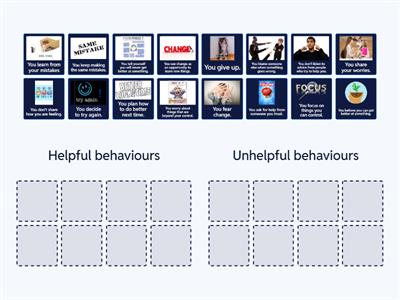
1.3 Give an example of how resilience can be developed (Helpful and unhelpful behaviours)
von
Ahead
Die richtige Gruppe
33
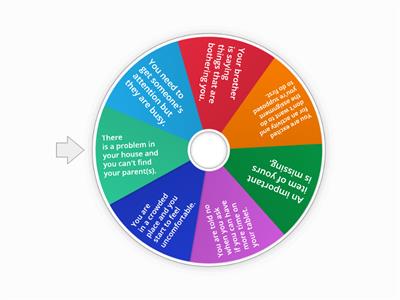
Coping and Problem-Solving Scenarios-Healthy or Unhealthy
von
Lisamuenchow
Öffnen Sie die Box
34
Positive and negative behaviours
von
Waynepalmer
Die richtige Gruppe
12
Good/ Bad - Behavior
von
Infantil8
Quiz
57
Scenarios - how can you show self-control in responding?
von
Morgandean
Glücksrad
7
Matching - Negative Thoughts vs. Coping Thoughts
von
Morgenrotl28
Die richtige Gruppe
14
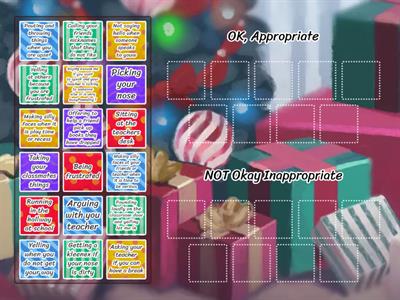
Appropriate and inappropriate behaviors
von
Tedeco
Die richtige Gruppe
5
Appropriate/Inappropriate behaviors
von
Academicho
Quiz
7
Vorlage ändern
Alle anzeigen
Offene Ergebnisse
Link kopieren
QR-Code
Löschen
Soll die automatisch gespeicherte Aktivität
wiederhergestellt werden?