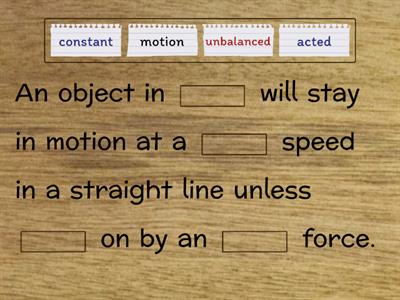
What happens to your mass on the moon?, It increases, it stays the same, It decreases, It disappears, The gravitational force between two objects is strongest when:, They are far apart, They are close and massive, They are small, They are moving fast, Which of these is NOT a force pair?, Hand pushes wall, wall pushes hand, Earth pulls apple, apple pulls Earth, Gravity pulls moon, moon pulls Earth, Gravity pulls ball, friction slows ball, What is the reaction force when you sit on a chair?, Chair pushing upward, Gravity pulling downward, Air resistance, Friction, What happens when two objects of different mass fall in vacuum?, Both fall at same rate, Neither falls, Heavier falls faster, Lighter falls faster, Why don’t we feel the gravitational pull of small objects?, They repel gravity, Their mass is too small, Gravity doesn’t affect small objects, They are too far, If Earth’s gravity disappeared, the moon would:, Fall to Earth, Stay in orbit, Fly off in a straight line, Spin faster, What is the unit of gravitational force?, Joule, Newton, Watt, Kilogram, Which of the following is a force pair?, Gravity and friction, Action and reaction, Mass and weight, Speed and velocity, Gravitational force is always:, Repulsive, Attractive, Neutral, Variable, What happens to gravitational force when distance increases?, It increases, It stays the same, It decreases, It disappears, Weight is:, Mass × gravity, Mass ÷ gravity, Gravity ÷ mass, Mass + gravity, What is the gravitational constant (G)?, 9.8 m/s², 6.67 × 10⁻¹¹ N·m²/kg², 3.14, 1.6 × 10⁻¹⁹ C, What does Newton’s third law state?, Objects in motion stay in motion, For every action, there is an equal and opposite reaction, Force equals mass times acceleration, Gravity pulls objects downward, A swimmer pushes water backward. What happens next?, Water pushes the swimmer forward, Water pulls the swimmer down, Water pushes the swimmer backward, D) Nothing, When a bird flaps its wings downward:, Air pushes the bird downward, Air pushes the bird upward, Gravity increases, D) Nothing happens, Which of the following best illustrates Newton’s First Law?, A ball rolling until friction slows it down, B) A rocket launching into space, A person pushing a box, D) A falling apple, Newton’s Second Law is expressed as:, F = m + a, F = m ÷ a, F = m × a, F = a ÷ m, Newton’s First Law states:, Force equals mass times acceleration, For every action, there is an equal and opposite reaction, An object in motion stays in motion unless acted on by a force, Gravity pulls objects toward Earth, Which example shows Newton’s Second Law?, A ball staying still, A person pushing a cart and it speeds up, A balloon floating, A book resting on a table
0%
science
Compartir
Compartir
por
Yasmenmagdiiii
Editar contenido...
Salvar
Me gusta
Imprimir
Incrustar
Más
Tareas
Tabla de clasificación
Mostrar más
Mostrar menos
Esta tabla de clasificación es actualmente privada. Haz clic en
Compartir
para hacerla pública.
Esta tabla de clasificación ha sido desactivada por el propietario del recurso.
Esta tabla clasificación está desactivada, ya que sus opciones son diferentes a las del propietario del recurso.
Revertir opciones
Abrecajas
es una plantilla abierta. No genera puntuaciones para una tabla de clasificación.
Requiere iniciar sesión
Estilo visual
Fuentes
Se necesita una suscripción
Opciones
Más bien así
Newton`s 2nd Law of Motion Vocabulary
por
Aelmer
Cada oveja con su pareja
7
Newton's Laws of Motion
por
Juliepollard
Completar la frase
51
Newton's Laws of Motion (Match up)
por
Lrharper
Une las parejas
6
Which force is it? Gravity or Friction - Applied Science
por
Kaylea1
Ordenar por grupo
20
Force & Motion / Newton's Laws
por
Alexiatesta
Une las parejas
4
Newtons Laws of Motion
por
Alejandral2120
Avión
18
Newton's 1st Law
por
Hindbjorgen
Une las parejas
4
Newtons Laws of Motion
por
Lorivinson64
Persecución en el laberinto
6
Cambiar plantilla
Mostrar todo
Resultados abiertos
Copiar enlace
Código QR
Eliminar
¿Restaurar actividad almacenada automáticamente:
?