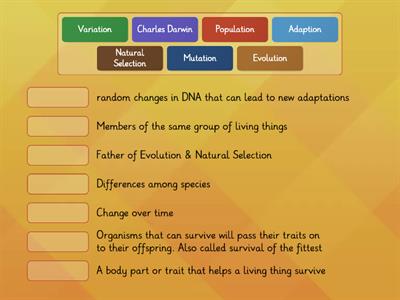
Define 'evolution', The change in organisms over time as a result of genomic variations, Define 'natural selection', The non-random increase in the frequency of advantageous alleles and the non-random decrease in the frequency of disadvantageous alleles in a population over time (increasing survival), Name the 3 types of natural selection?, Directional, disruptive, stabilising, Describe stabilising selection?, An average phenotype is selected for and extreme phenotypes are selected against, Describe directional selection?, One extreme of the phenotype range is selected for, Describe disruptive selection?, The extremes of the phenotype range are selected for and the average phenotypes selected against, What is the difference between vertical and horizontal gene transfer?, Vertical is the passing of genes from parents to offspring (from generation to generation), horizontal is where genes are transferred between individuals of the same generation, Why is natural selection faster in prokaryotes than eukaryotes?, As although both can transfer genes vertically, prokaryotes i.e. bacteria can also transfer genes horizontally, resulting in faster evolutionary change, Vertical gene transfer can be sexual or asexual. Give examples of asexual reproduction in a) plants and b) bacteria?, Plants - any type of vegetative propagation i.e. bulbs, tubers and runners, bacteria - through fission (mitosis to produce daughter cells), Define 'species', A group of organisms capable of interbreeding and produce fertile offspring (which do not normally breed with other groups), Define speciation?, The generation of a new biological species as a results of isolation, mutation and selection, Name the two types of speciation?, Allopatric and sympatric, Name the 3 types of isolation barrier with examples of each?, Geographical i.e. rivers and mountains, ecological i.e. different temperature requirements or occupying different habitats in the same area, behavioural i.e. different mating preferences, Why are isolation barriers vital in speciation?, They prevent gene flow between members of the sub population to ensure they evolve separately, Describe the stages of speciation - long answer!, 1 - Original species are separated by an isolation barrier, 2 - Different random mutations occur in each sub population, 3 - Due to differing selection pressures, natural selection occurs in each sub population over time (advantageous alleles improving survival increase in frequency over time and the allele frequencies change), 4 - If the barrier is removed the sub populations are now two separate species
0%
1.7 Evolution
共有
共有
Inezimray1
さんの投稿です
コンテンツの編集
セーブ
いいね!
印刷
埋め込み
もっと見る
割り当て
リーダーボード
もっと表示する
表示を少なくする
このリーダーボードは現在非公開です。公開するには
共有
をクリックしてください。
このリーダーボードは、リソースの所有者によって無効にされています。
このリーダーボードは、あなたのオプションがリソースオーナーと異なるため、無効になっています。
オプションを元に戻す
フラッシュカード
は自由形式のテンプレートです。リーダーボード用のスコアは生成されません。
ログインが必要です
表示スタイル
フォント
サブスクリプションが必要です
オプション
もっとこんな感じだ
Natural selection quiz
Cyoung
さんの投稿です
クイズ
10
Evolution and Genetics
Denita
さんの投稿です
ゲームショウ・クイズ
6
Evolution & Natural Selection
Msondrusbiology
さんの投稿です
マッチアップ
36
Evolution of a species
Carolinemcg3
さんの投稿です
マッチアップ
7
8.L.4 Evolution Quizlet Terms
Kimberlyd
さんの投稿です
迷路の追跡
5
Science Terms (Intro to Evolution)
Caitlyn21
さんの投稿です
マッチアップ
3
Speciation - Recap
Akanksha1
さんの投稿です
一致するものを見つける
3
Evolution & Natural Selection Terms
Leahy
さんの投稿です
マッチアップ
3
テンプレートを切り替える
すべてを表示
オープン結果
リンクをコピー
QRコード
削除
自動保存:
を復元しますか?