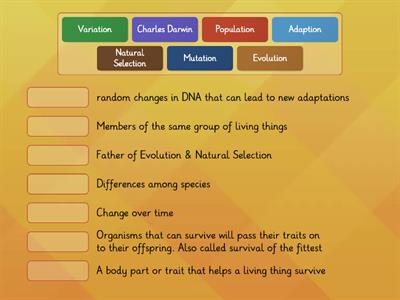
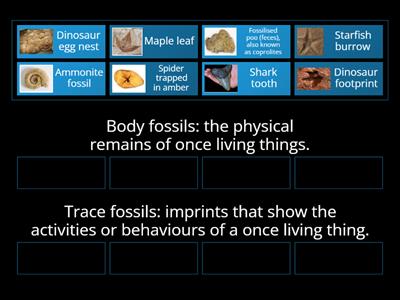
Biological Evolution, the change of living things over time, Mutations, changes in DNA that sometimes change and organism’s traits, Variations, small differences in a single trait, Adaptations, inherited traits that increase an organism’s chance of surviving and reproducing in its environment, Structural Adaptations, adaptations related to the physical features of an organism, Behavioral Adaptations, adaptations related to the way that an organism acts, Functional Adaptation, adaptations related to how an organism’s body actually works, Camouflage, An adaptation that allows a species to blend in with its environment, Mimicry, An adaptation that allows one organism to look like another organism, Migration, Seasonal movement from one area to another, Group Living, An adaptation where organisms live together for protection, to get food, and to have complex societies, Communication, An adaptation where organisms send messages to each other through sound, colors, smells,, Warm Blooded, Organisms who can control their own body temperature, Cold Blooded, Organisms who need the environment to help them control their body temperature, Natural Selection, the process where individuals with better traits/variations for the environment survive better and reproduce more than other individuals, Overpopulation, Species must reproduce and overpopulate., Variation, All offspring will have slightly different traits., Competition, The organisms that are the best suited for their environments will outlive others and survive. “Survival of the Fittest” (for their environment), Selection, The survivors that are “selected” can pass their more favorable traits on to their offspring. Selected means that an organism just happened to be able to survive, Artificial Selection, The process where humans breed organisms to produce desirable traits until a new species or subspecies is created, Fossil Record, All the fossils ever found on Earth, Fossil, The remains or traces of an organism that are usually preserved in rock, Extinction, When the last individual of a species dies, Mineralization, Tissues in the organism are replaced by minerals The organism appears to “turn to stone”, Carbonization, Organism is pressed under layers of rock over a long period of time Requires a lot of pressure & only outline remains, Molds and Casts, Mold - an impression of an organism, Cast - a fossil copy of an organism, Trace Fossils, The evidence of activity of an organism, Original Material, Actual material of an organism preserved in a substance like amber or ice, Homologous, Body parts that have the same structure but different functions/jobs, Analogous, Body parts that have the same function/job but a different structure, Vestigial, Body parts that no longer serve their original purpose/function
0%
Evolution
共有
共有
Miphair
さんの投稿です
G6
Science
コンテンツの編集
セーブ
いいね!
印刷
埋め込み
もっと見る
割り当て
リーダーボード
もっと表示する
表示を少なくする
このリーダーボードは現在非公開です。公開するには
共有
をクリックしてください。
このリーダーボードは、リソースの所有者によって無効にされています。
このリーダーボードは、あなたのオプションがリソースオーナーと異なるため、無効になっています。
オプションを元に戻す
フラッシュカード
は自由形式のテンプレートです。リーダーボード用のスコアは生成されません。
ログインが必要です
表示スタイル
フォント
サブスクリプションが必要です
オプション
もっとこんな感じだ
Evolution & Natural Selection
Msondrusbiology
さんの投稿です
マッチアップ
36
Year 6 Evolution - Body Fossils & Trace Fossils
Ahamilton
さんの投稿です
グループ仕分け
5
Science Living Things
Kcksaunders89
さんの投稿です
グループ仕分け
6
Evidence of Evolution (Part 2)
Albredehoft
さんの投稿です
ワードサーチ
3
Science Quiz- Adaptation
Ishajha23aug
さんの投稿です
飛行機
3
Science Terms (Intro to Evolution)
Caitlyn21
さんの投稿です
マッチアップ
3
Evolution & Natural Selection Terms
Leahy
さんの投稿です
マッチアップ
3
Adaptations of Living Things
P0076663
さんの投稿です
グループ仕分け
4
テンプレートを切り替える
すべてを表示
オープン結果
リンクをコピー
QRコード
削除
自動保存:
を復元しますか?