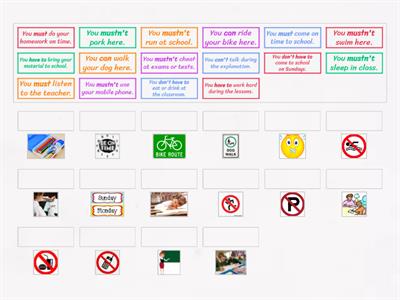
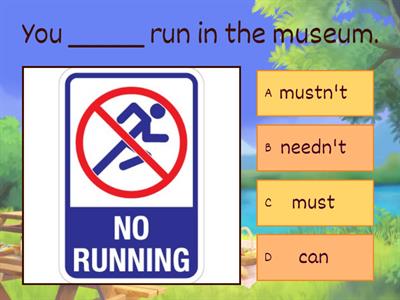
1. I must wake up early 2.I have to wake up early., • must - internal obligation; something that's important for the speaker; • have to - external obligation; something the speaker does because they have no choice., 1. You can’t write here. 2.You don’t have to write here., Can’t- prohibition. • Don’t have to - absence of obligation; it’s not necessary, but you can do it if you want., 1. Mark has to be home at 7. 2. Mark should be home at 7., • Has to - expresses either obligation or necessity; most likely, he has no choice and will be home at 7. • Should - expresses probability; Mark is expected to be home at 7 because he usually is, but it might not happen., 1. The fish doesn’t smell good; it may be spoilt. 2.The fish doesn’t smell good; it might be spoilt., No difference., 1. You should try schnitzel in Vienna. 2. You must try schnitzel in Vienna., Both give advice, but the one with must is slightly stronger., 1. He couldn’t be serious. 2.He can’t be serious., Couldn’t - expresses a lack of ability in the past; can be replaced with wasn’t able to. With can’t, there are two options: either a lack of ability in the present, or a logical assumption (e.g., I think he’s not serious)., 1. The students can’t use dictionaries during the test. 2.The students may not use dictionaries during the test., Both sentences talk about prohibition. May not is more formal., 1. You should exercise more. 2.You could try exercising more., Both sentences give advice or recommendations, but could try is slightly more polite.

Explain the difference

Tabela rankingowa

Motyw

Opcje

Zmień szablon

Przywrócić automatycznie zapisane ćwiczenie: ?