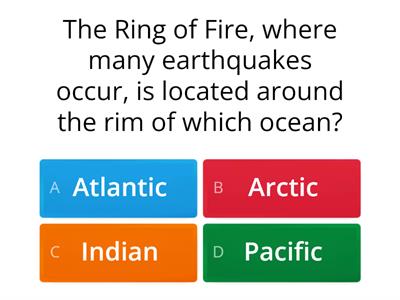
Which layer of the Earth do earthquakes happen in?, Core, Mantle, Crust, Outer space, What do we call the point underground where the earthquake starts?, Epicenter, Fault, Focus, Crust, Which seismic wave causes the most damage?, P waves, S waves, Surface Waves, None of the above, What moves along cracks in the Earth’s crust and stores energy before an earthquake?, Faults, Epicenters, Aftershocks, P waves, After the main earthquake, smaller quakes may occur. What are they called?, Surface waves, Aftershocks, P waves, Magnitude, The point on the Earth’s surface directly above the focus is called:, Focus, Epicenter, Fault, Mantle, Large sections of the Earth’s crust that slowly move are called:, Faults, Tectonic plates, Seismic waves, Mantle layers, The fastest seismic waves, which travel through solids, liquids, and gases, are called:, P waves, S waves, Surface waves, Aftershocks, Seismic waves that move only through solids are called:, P waves, S waves, Surface waves, Fault waves, Surface waves travel along the Earth’s surface and:, Cause no damage, Cause the most damage, Travel faster than P waves, Move only underground, The pressure that builds up along a fault is eventually released as:, Earthquake, Volcano, Landslide, Tsunami, Magnitude measures:, How strong shaking feels, Total energy released by an earthquake, Distance from epicenter, Type of seismic wave, Which of the following is NOT a type of seismic wave?, P waves, S waves, Surface waves, Crust waves, Intensity measures:, The total energy released, How strong shaking feels at a location, The speed of the waves, The size of the tectonic plates, Why do aftershocks occur?, The Earth’s crust is adjusting after the main quake, New earthquakes always start in the mantle, The epicenter moves to another location, P waves continue traveling
0%
Multiple Choice
Compartilhar
Compartilhar
de
Zyrhylkymh
G7
Editar conteúdo
Salvar
Curtir
Imprimir
Incorporar
Mais
Atribuições
Ranking
Mostrar mais
Mostrar menos
Atualmente, este ranking é particular. Clique em
Compartilhar
para torná-lo público.
Este ranking foi desativado pelo proprietário do recurso.
Este ranking está desativado, pois suas opções e as do proprietário do recurso são diferentes.
Reverter opções
Abra a caixa
é um modelo aberto. Ele não gera pontuações para um ranking.
Login necessário
Estilo visual
Fontes
Assinatura necessária
Opções
Mais assim
Earthquakes
de
Hkheirabi
Questionário
13
The Earthquake
de
Missmarinaposeb
Questionário
8
The Earthquake activity
de
Laubeaok
Associação
3
Earthquakes and Faults
de
Lovely13
Game show de TV
6
Earthquakes
de
Dolans5
Verdadeiro ou falso
5
Earthquakes/Volcanoes Review
de
Ksalmon
Questionário
3
Earthquakes and Volcanoes Review
de
Burrowsireland
Associação
3
Earthquakes and volcanoes
de
Wrsayed
Questionário
3
Alterar modelo
Mostrar todos
Resultados em aberto
Copiar link
Código QR
Excluir
Restaurar arquivo salvo automaticamente:
?