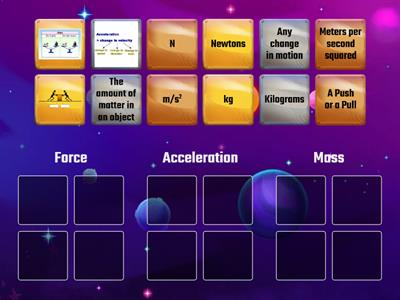
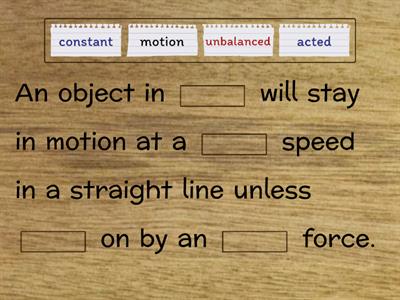
Newton’s First Law is also called:, Law of Acceleration, Law of Inertia, Law of Energy, Law of Action and Reaction, In the equation F = ma, the symbol “m” represents:, Motion, Momentum, Mass, Meter, Kinetic energy depends on:, Mass and height, Force and displacement, Spring constant and distance, Mass and speed, In a free-body diagram, the first step is to:, Resolve forces, Apply Newton’s Second Law, Isolate the object of interest, Calculate energy, A 5 kg object has an acceleration of 3 m/s². What is the net force acting on it?, 8 N, 15 N, 2 N, 30 N, A roller coaster cart has a mass of 500 kg and is at a height of 60 m. Taking g = 9.8 m/s², what is its potential energy?, 29,400 J, 294,000 J, 3,000 J, 500,000 J, Which of the following best describes conservation of energy?, Energy can be created when needed, Energy can disappear during motion, Energy cannot be created or destroyed, only transformed, Energy is always equal to force, If the net force on an object is zero, the object:, Must be accelerating, Must be moving in a circle, Remains at rest or moves with constant velocity, Must stop immediately, A spring with spring constant k = 200 N/m is stretched by 0.05 m. What is the restoring force?, 4 N, 10 N, 200 N, 0.25 N, A 500 kg roller coaster cart starts from rest at a height of 60 m. Ignoring friction, what is its approximate speed when it reaches a height of 56 m? Take g = 9.8 m/s²., 4.4 m/s, 8.9 m/s, 12.5 m/s, 19.6 m/s
0%
Day 2
Partajează
Partajează
de
Rabumosa
Editează conținutul
Salvează
Apreciază
Imprimare
Încorporează
Mai multe
Misiuni
Clasament
Arată mai mult
Arată mai puțin
Acest clasament este în prezent privat. Fă clic pe
Distribuie
pentru a-l face public.
Acest clasament a fost dezactivat de proprietarul resursei.
Acest clasament este dezactivat, deoarece opțiunile tale sunt diferite de ale proprietarului resursei.
Opțiuni de revenire
Roata aleatoare
este un șablon deschis. Nu generează scoruri pentru un clasament.
Este necesară conectarea
Stilul vizual
Fonturi
Este necesar un abonament
Opţiuni
Mai degrabă așa
Newton`s 2nd Law of Motion Vocabulary
de
Aelmer
Găsește perechea
7
Newton's Second Law
de
Juliepollard
Sortare în funcție de grup
14
Newton's Laws of Motion
de
Juliepollard
Completați propoziția
51
Newton's Laws of Motion (Match up)
de
Lrharper
Potrivește
6
Newtons Laws of Motion
de
Alejandral2120
Avion
18
Newtons Laws
de
Lrharper
Chestionar
22
Newton's 2nd Law
de
Eboehm
Clasament
8
Newtons Laws of Motion
de
Lorivinson64
Cursa în labirint
6
Comutare șablon
Arată tot
Rezultate deschise
Copiați linkul
Cod QR
Şterge
Restaurare activitate salvată automat:
?