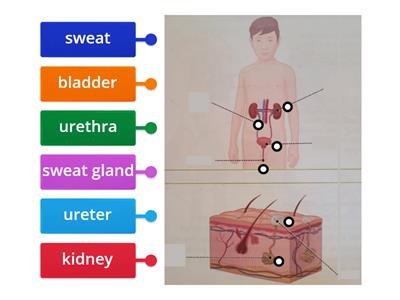
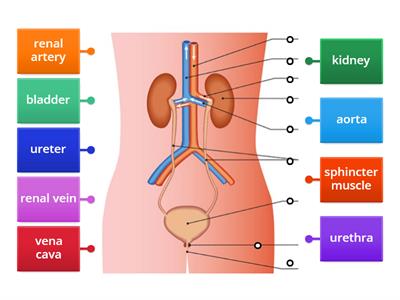
ureters, The tubes that transport urine from the kidneys to the urinary bladder, urethra, The structure that transports urine from urinary bladder to the exterior. Males = 6-7-8 Inches & Females = 1-1.5 Inches, excretion, The removal of waste products from body, urine, The end product of kidney function, urea, This is produced by the liver; less toxic form of ammonia & gives pee its smell, nephrons, A functional units of the kidney, urinary bladder, The halo and stretchy temporary storage for urine, ADH, The hormone that tells kidneys to reabsorb more water, transitional epithelium, The specific tissue type that makes up the urinary bladder, what determines IF you CAN go to the restroom or NOT., micturition, A series of contractions of the urinary bladder in order to empty its contents, glomerulus, A ball of capillaries inside each the 800,000 - 1.5 million nephrons, bowman's capusle, The cup-shaped structures that surround each one of the ball of capillaries (where filtrate travels)), collecting duct, The end product of nephron filtration is funneled here, adrenal glands, These are found on top of each kidney and function to secrete essential hormones including cortisol, aldosterone, and adrenaline—to manage metabolism, blood pressure, stress response (fight or flight), and immune system function., renal cortex, The outer region of kidney covered by the renal capsule., renal medulla, The inner region of the kidney just deep to the renal cortex., renal pelvis, The central space within kidney, where all of the pyramids empty into collecting urine (the pee pee pool), medullary pyramids, The triangular/pyramid shaped tissue inside kidney that receive the filtrate once produced by the nephrons., renal columns, The extensions of the cortex tissue in between the pyramids., calyx, The cup shaped structure at the bottom of each pyramid that drains urine into the renal pelvis., filtration, Process that occurs inside the bowman's capsule, where fluid from blood plasma (minus proteins & blood cells) is removed and leaves the blood capillaries, reabsorption, Most of the water (80%) and many ions and nutrients are reabsorbed into the blood Location: Proximal (near) convoluted tubule & Loop of Henle, secretion, The additional substances are actively removed from the blood (h+, drugs, steroids) Location: distal (far) convoluted tubule, being removed from the filtrate., dialysis, The process needed when the kidneys are NOT able to function well this procedure can be done to help do what the kidneys should be doing., homeostasis, Process by which the kidneys regulate blood volume, blood pressure, ion concentration, blood pH, conserves nutrients, assists liver in detoxification, kidney, Two organs that removes urea, excess water, and other waste products from the blood and passes them to the ureter, renal capsule, The most superficial tissue that covers the outer surface of the kidney, urine formation, The fine tuning of K+ and H+ in the urine to regulate levels in blood, Urine is transported to renal pelvis to be removed from the body via the urethrae, renal artery, The blood vessel that carries blood to the kidney, renal vein, The blood vessel that carries blood away from the kidney, Nephrons, Average 800,000 -1.5 Million of these functional units inside of each kidney, I am not sure if you can or not, What Mrs. P says when a student asks "Can I go to the Restroom"?
0%
Urinary System
共享
共享
由
Cpauly
编辑内容
保存
喜欢
打印
嵌入
更多
作业
排行榜
显示更多
显示更少
此排行榜当前是私人享有。单击
,共享
使其公开。
资源所有者已禁用此排行榜。
此排行榜被禁用,因为您的选择与资源所有者不同。
还原选项
拼字游戏
是一个开放式模板。它不会为排行榜生成分数。
需要登录
视觉风格
字体
需要订阅
选项
更像是这样
EXCRETORY SYSTEM
由
Martaferreirog
完成句子
11
Kidney Nephron
由
Rydalbiologyww
标记图表
19
Urinary System Vocabulary
由
Stitzel
匹配游戏
3
Label the parts of Nephron
由
Sivalakshmi
标记图表
6
Urinary system - kidney structure
由
Sageyarr
标记图表
4
Excretory System
由
Denise161
标记图表
7
Structure of Urinary System and Kidneys
由
Msgalligan
标记图表
5
LC Biology - Urinary System
由
Paulaconroy7
标记图表
3
切换模板
显示所有
打开成绩
复制链接
QR 代码
删除
恢复自动保存:
?