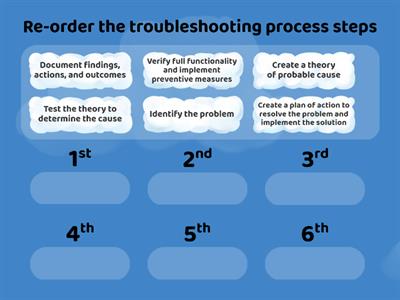
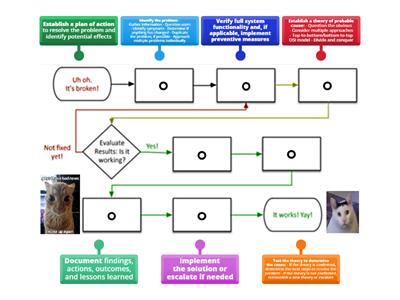
Identify the problem, Ask the user to describe the problem or symptoms, check for error messages, or recreate the problem., Identify what has changed, Establish what has changed. Most often, problems are caused by new hardware, software, or configuration changes. If necessary, ask users to recall what might have changed from the time the software worked and the time it didn't. Remember to inquire about environmental and infrastructure changes that could be relevant, Create hypothesis, With the information gathered in the preceding steps, conduct research and then develop several hypotheses that could potentially explain the problem. From your research and the information you have already gathered, narrow your hypotheses down to the one or two mostly likely causes., Determine the appropriate fix, Review knowledge bases, other websites, and your own experience to identify steps to remedy the problem. Before implementing any steps, think through all possible ramifications that might occur from the planned fixes. Often, the fix itself creates side effects that are just as bad or worse than the original issue, Implement the fix, It's finally time to implement the steps of the fix you have planned. Resist the urge to jump into troubleshooting by starting with this step., Verify functionality, After implementing the fix, verify that the fix repaired the problem. If the problem still exists or a new problem appears, start back at step one again., Document the solution, It might be tempting to move on to other problems, but be sure to document the previous six steps. This will save a lot of time and effort if the problem happens again in say a year or two.
0%
Troubleshooting Process
Podeli
Podeli
autor
Alara42
Secondary
Computing
Uredi sadržaj
Sačuvaj
Sviđa mi se
Odštampaj
Ugradi
Više
Zadatke
Tabela
Prikaži više
Prikaži manje
Ova tabela je trenutno privatna. Kliknite na
Podeli
da biste je objavili.
Pristup tabeli je onemogućio vlasnik sredstva.
Ova tabela je onemogućena pošto Vam se podešavanja razlikuju od podešavanja vlasnika sredstva.
Vrati podešavanja
Spoji
je otvoreni šablon. On ne generiše rezultate za tabelu rangiranja.
Prijava je obavezna
Vizuelni stil
Fontove
Potrebna je pretplata
Postavke
Više poput ovoga
What would you do problem solving
autor
Kferrante
Kviz
37
Troubleshooting advance computing system steps
autor
Nahidabughname
Spoji
5
Troubleshooting process steps
autor
Lubnaalmeshaiei
Redosled
5
CompTIA Troubleshooting Methodology
autor
Freemanc176
Vrsta grupe
22
Problem solving
autor
Annashastak
Nasumični točak
4
Problem solving
autor
Todoaba
Kviz
6
Problem-solving
autor
Ciaranmckeon
Vrsta grupe
3
network+ troubleshooting methodology
autor
Shreksnose
Dijagram sa oznakama
7
Promeni šablon
Prikaži sve
Otvoreni rezultati
Kopiraj vezu
QR kôd
Izbriši
Vrati automatski sačuvano:
?