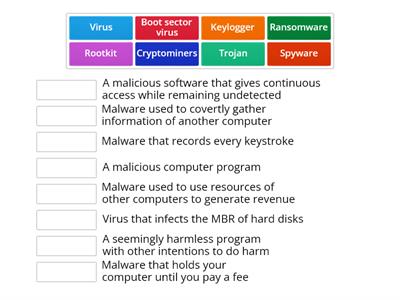
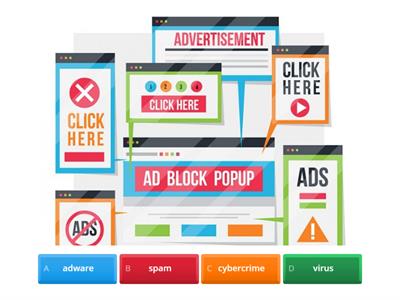
Virus, Self-replicating program that attaches to legitimate files., Worm, Standalone malware that spreads through networks automatically., Trojan, Malware disguised as a legitimate program to trick users into running it., RAT, Remote Access Trojan allowing full control over an infected system, Backdoor, Unauthorized access method to a system, bypassing security mechanisms, Botnet, A network of infected devices controlled remotely., Logic Bomb, A hidden malicious code that triggers under specific conditions., Rootkit, Stealthy malware that hides its presence and allows continued access., Zero-Day, A previously unknown software vulnerability exploited by attackers., Advanced Persistent Threat, Long-term cyber espionage targeting organizations or governments., Ransomware, Encrypts files and demands payment for decryption., Spyware, Secretly gathers user information and sends it to an attacker., Adware, Displays unwanted advertisements, often in a deceptive manner., SPAM, Unsolicited bulk email, often containing phishing or malware links., Adware Example, Fireball - Hijacked web browsers to generate ad revenue and install additional malware., Ransomware Example, CryptoLocker - Encrypted user files and demanded Bitcoin payments for decryption keys., Backdoor Example, Back Orifice - Provided remote administrative control over Windows machines., Virus Example, Mydoom - Spread through email attachments, performing mass email spamming and launching DDoS attacks., Worm Example, WannaCry - Exploited a Windows vulnerability to spread ransomware, encrypting user files and demanding payment., SPAM Example, Love Bug (ILOVEYOU) - Spread through email with an infected attachment, overwriting files and sending itself to contacts., Spyware Example, Pegasus - Highly sophisticated spyware used for the surveillance of journalists and activists., Advanced Persistent Threat Example, APT28 (Fancy Bear) - Russian state-sponsored hacking group targeting political organizations., Zero-Day Example, Aurora Exploit - Used to attack Google and other tech firms by exploiting an Internet Explorer vulnerability., Rootkit Example, Stuxnet - Targeted Iranian nuclear facilities by manipulating industrial control systems., Logic Bomb Example, CIH (Chernobyl) - Activated on specific dates, overwriting hard drives and BIOS firmware., Botnet Example, Mirai Botnet - Infected IoT devices to launch massive DDoS attacks., RAT Example, DarkComet - Allowed attackers to spy on victims, log keystrokes, and control webcams remotely., Trojan Example, Zeus Trojan - Stole banking credentials by logging keystrokes and intercepting online transactions.
0%
Malware & Examples
Deli
Deli
ustvaril/-a
Jscurtis
High
CS
Uredi vsebino
Shrani
Všečkaj
Natisni
Vdelaj
Več
Naloge
Lestvica vodilnih
Prikaži več
Prikaži manj
Ta lestvica je trenutno zasebna. Kliknite
Deli
, da jo objavite.
Lastnik vira je onemogočil to lestvico vodilnih.
Ta lestvica vodilnih je onemogočena, ker se vaše možnosti razlikujejo od možnosti lastnika vira.
Možnosti za vrnitev
Ujemanje
je odprta predloga. Ne ustvarja rezultatov za lestvico vodilnih.
Potrebna je prijava
Vizualni slog
Pisave
Zahtevana je naročnina
Možnosti
Bolj takole
Comptia A+ Core 2 - 7 steps of Malware Removal Process
ustvaril/-a
Margaritastudying
Ujemanje
56
Security+: Malware Types
ustvaril/-a
Terry22
Ujemanje
23
Malware
ustvaril/-a
Benzi
Ujemanje
5
Network Attacks 11.6 Vocab
ustvaril/-a
Benzi
Razvrščanje skupin
3
DayDayUp IT Course - Lesson 27 - Malware vocabulary
ustvaril/-a
Schooldaydayup
Flash karte
3
Malware - Comptia A+ 1102
ustvaril/-a
Jesus38383
Ujemanje
85
malware
ustvaril/-a
23tomla12
Ujemanje
5
Computer Security Words
ustvaril/-a
Educoot
Kviz
3
Preklopi predlogo
Pokaži vse
Odprti rezultati
Kopiraj povezavo
QR koda
Izbriši
Obnovi samodejno shranjeno:
?