Noun, A person, place, thing, or idea., Verb, An action or state., Modal verb, A verb that expresses necessity or possibility., Imperative, A command or order., Adverb, A word that modifies a verb, adjective, or another adverb., Adjective, A word that describes a noun., Pronoun, A word used in place of a noun., Superlative, An adjective showing the highest degree or quality., Symbolism, The use of symbols to represent ideas or qualities., Alliteration, The same letter or sound at the start of nearby words., Metaphor, A direct comparison of two things without using like or as., Simile, A comparison using like or as., Personification, Giving human characteristics to a non-human object., Semantic field, A group of words linked by a common topic., Hyperbole, Exaggeration that is not meant to be taken literally., Imagery, Vivid descriptive language that creates a picture in the reader’s mind., Auditory imagery, Description that appeals to sound., Tactile imagery, Description that appeals to touch or physical feeling., Olfactory imagery, Description that appeals to smell., Gustatory imagery, Description that appeals to taste., Kinesthetic imagery, Description that appeals to movement or body position., Simple sentence, A sentence with one clause containing a subject and verb., Compound sentence, A sentence with two main clauses joined by a conjunction., Complex sentence, A sentence with at least one main clause and one subordinate clause., Impact sentence or fragment, A very short sentence, often three words or fewer., Repetition, A word or phrase used more than once for emphasis., Triple, Three words or phrases grouped together., Juxtaposition, Placing two contrasting ideas close together., Anaphora, Repetition of a word or phrase at the start of successive clauses., Listing, A series of connected items written one after another., Links between paragraphs, A recurring idea, character, or object across paragraphs., Shifts in focus, A change in focus within or between paragraphs., Zooming in and out, Moving from a broad view to a close detail, or the reverse., Chronological structure, Events arranged in time order., Flashback or flashforward, A shift to an earlier or later point in time., Links between the beginning and ending, A connection between the beginning and the end of a text., Exposition, Background information about characters, events, or setting., Climax, The most intense or important moment in a narrative., Narrative voice, The perspective from which the story is told, such as first, second, or third person., Direct speech, The exact words spoken by a character shown in speech marks., Tense, The time frame of a verb, such as past, present, or future., Foreshadow, A hint or clue about what will happen later.
0%
Language Techniques
Deli
Deli
ustvaril/-a
Twteachandtutor
Uredi vsebino
Shrani
Všečkaj
Natisni
Vdelaj
Več
Naloge
Lestvica vodilnih
Prikaži več
Prikaži manj
Ta lestvica je trenutno zasebna. Kliknite
Deli
, da jo objavite.
Lastnik vira je onemogočil to lestvico vodilnih.
Ta lestvica vodilnih je onemogočena, ker se vaše možnosti razlikujejo od možnosti lastnika vira.
Možnosti za vrnitev
Pokanje balonov
je odprta predloga. Ne ustvarja rezultatov za lestvico vodilnih.
Potrebna je prijava
Vizualni slog
Pisave
Zahtevana je naročnina
Možnosti
Bolj takole
Language Techniques and definition
ustvaril/-a
Hsmith87
Ujemanje
53
Common Poetic Techniques (Language)
ustvaril/-a
Jack
Ujemanje
7
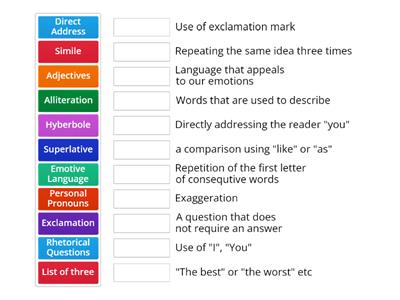
Language techniques
ustvaril/-a
Chantelle
Ujemanje
19
Word types, language techniques and sentence structures
ustvaril/-a
Lottiebrant
Ujemanje
10
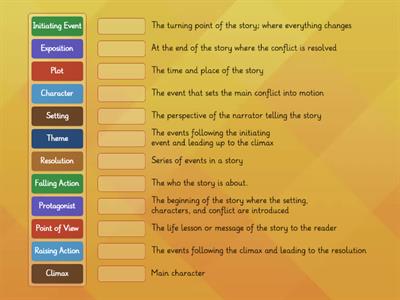
Elements of a Story Vocabulary
ustvaril/-a
Laraarnold
Ujemanje
23
Figurative Language, Literary Elements, Plot
ustvaril/-a
Kirbya1
Kviz
16
Elements of a Story - Vocabulary
ustvaril/-a
Belenvquez
Igralni kviz
10
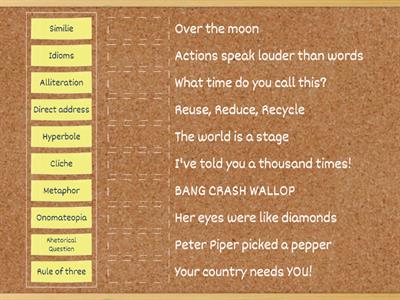
Language Techniques
ustvaril/-a
Cmcgreevy429
Ujemanje
16
Preklopi predlogo
Pokaži vse
Odprti rezultati
Kopiraj povezavo
QR koda
Izbriši
Obnovi samodejno shranjeno:
?