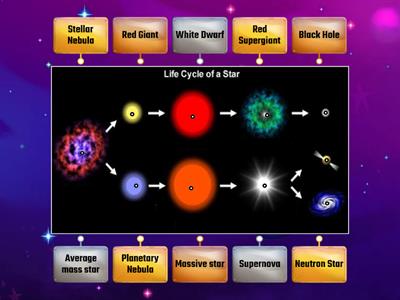
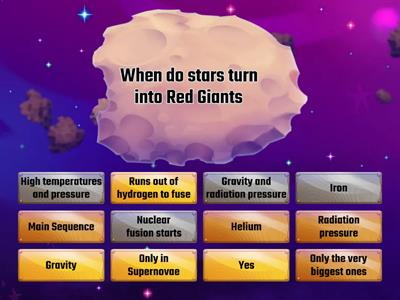
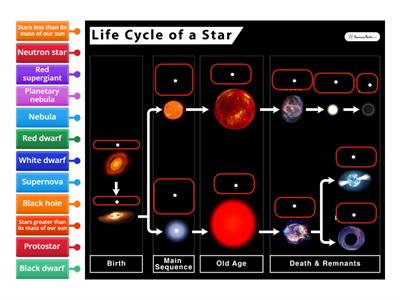
True Statements, A star’s entire life cycle at every stage is controlled by two counteracting forces: inward gravity and outward balancing pressure., Cold, dense interstellar molecular clouds filled with cosmic gas and dust are the birthplace of all newly forming stars., Hydrogen gas, helium gas, and tiny microscopic cosmic dust particles make up the main composition of molecular clouds., Shockwaves produced by nearby exploding stars break the stable state of molecular clouds and make dense clumps collapse under gravity., Thick compact clumps created from collapsing molecular cloud matter develop into protostar objects first., A protostar’s core must hit around ten million Kelvin to start hydrogen fusion ignition at its center., A protostar officially becomes a main sequence star when steady hydrogen fusion begins running inside its core., The main sequence phase is the longest and most stable life stage that any star will go through., Hydrostatic equilibrium inside stars balances inward gravitational pull against two outward forces: thermal pressure and radiation pressure., A star’s time as a stable main sequence body ends when its central core runs completely out of hydrogen fuel., A star’s starting total mass at the beginning of its main sequence stage decides all its later evolutionary steps once core hydrogen runs out., Stars cannot form in empty interstellar vacuums because nuclear fusion reactions cannot take place within undisturbed void space., New stars do not form within white dwarf atmospheres or the leftover clouds from supernova explosions., Simply letting cloud particles slowly cool does not create enough disruption to trigger gravitational collapse of a molecular cloud., Constant hydrostatic equilibrium balance lets main sequence stars hold a consistent size and brightness level over time., Compared to a star’s initial mass, rotation speed, surface temperature, and convection cell count only have minor effects on late stellar evolution., Sustained hydrogen core fusion marks the transition point from a developing protostar to a fully functional main sequence star., Gravitational collapse of molecular cloud clumps is initiated by shockwaves from neighboring stellar explosions, not slow cooling processes., Hydrostatic equilibrium relies on thermal and radiation pressure pushing outward to counteract the inward pull of stellar gravity., After a star’s core hydrogen fuel is fully used up, its initial mass sets the entire path of its remaining life stages., False Statements, A single outward force of gravity alone controls every stage of a star’s full life cycle., New stars form inside hot, empty interstellar vacuum regions with no gas or dust material present., Molecular clouds are mostly made of heavy metal gases and large rock fragments instead of hydrogen, helium, and fine dust., Gentle cooling of cloud particles creates shockwaves that break molecular cloud stability and trigger gravitational collapse., Protostars are the final stage of stellar evolution, forming long after a star leaves the main sequence phase., Hydrogen fusion ignites inside a protostar’s core once core temperatures only reach a few thousand Kelvin., A protostar becomes a main sequence star as soon as it finishes fully collapsing, before any core fusion begins., The red giant phase is the longest and most stable lifespan stage for all stars across the universe., Hydrostatic equilibrium balances outward gravity against a single inward thermal pressure force inside stars., A star’s main sequence stable lifespan ends once its outer atmosphere loses hydrogen fuel, not its central core., A star’s surface temperature and rotation speed fully determine its late evolution path, with initial mass having almost no impact., Nuclear fusion easily occurs inside empty interstellar vacuums, so stars commonly form within total void spaces., White dwarf atmospheres and supernova remnant clouds are the primary environments where brand-new stars form., Slow cooling of molecular cloud particles creates enough disruption to start immediate gravitational collapse of cloud clumps., Main sequence stars constantly shift in size and luminosity because they lack permanent hydrostatic equilibrium balance., A star’s initial mass has a stronger secondary impact than rotation speed and surface temperature on its late-stage evolution., Shockwaves from quiet, stable main sequence stars trigger molecular cloud collapse to form new protostars., Hydrostatic equilibrium only uses thermal pressure to counteract gravity, with radiation pressure playing no balancing role., A star’s core helium depletion is the event that ends its stable main sequence lifetime., Dense molecular cloud clumps first develop into fully formed main sequence stars without passing through a protostar stage.
0%
Stellar Evolution
共用
共用
由
Drkirillsadikov
編輯內容
存檔
喜歡
列印
嵌入
更多
需要登錄
視覺風格
顯示所有
字體
活動設定
排行榜
作業
需要訂閱
活動設定
排行榜
此排行榜當前是私有的。單擊
共用
使其公開。
資源擁有者已禁用此排行榜。
此排行榜被禁用,因為您的選項與資源擁有者不同。
還原選項
顯示更多
顯示更少
真假遊戲
是一個開放式範本。它不會為排行榜生成分數。
作業
您尚未與學生分享任何活動
要開始收集結果,請轉到任何活動頁面,然後選擇
Set assignment(設置分配
)。
確認您的設置並與學生共用生成的連結。
課業分配
更像這樣
GC_States of matter 1
由
Pnjeco
按組排序
10
Solid Matter
由
Alunas
打地鼠
4
Life Cycle of a Star
由
Harden1
標籤圖表
27
Life Cycle of Star Processes
由
Elizabeth312
查找匹配項
5
States of matter True or false
由
Elizabeth312
真假遊戲
24
Solar system - True or false
由
Redbusteachers
真假遊戲
7
Properties of Stars
由
Pricerebecca
匹配遊戲
3
(Year 10) Life cycle of a star
由
Gomeschool
標籤圖表
3
AI 強化版:此活動包含 AI 生成的內容。
了解更多。
切換範本
顯示所有
打開結果
複製連結
QR 代碼
刪除
恢復自動保存:
?