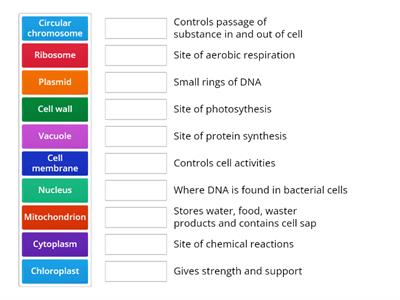
bacteriophage, kind of virus that infects bacteria, capsid, protein coat surrounding a virus, cell, basic unit of all forms of life, cell membrane, thin, flexible barrier that surrounds all cells; regulates what enters and leaves the cell, cell theory, fundamental concept of biology that states all living things are composed of cells; that cells are the basic units of structure and function in living things; and that new cells are produced from existing cells, cell wall, strong, supporting layer around the cell membrane in some cells, choloroplast, organelle found in cells of plants and some other organisms that captures the energy from sunlght and converts it into chemical energy, cytoplasm, in eukaryotic cells, all cellular contents outside the nucleus; in prokaryotic cells, all of the cells' contents, cytoskeleton, network of protein filaments in a eukaryotic cell that gives the cell its shape and internal organization and is involved in movement, Golgi apparatus, organelle in cells that modifies, sorts, and packages proteins and other material from the endoplasmic reticulum for storage in the cell or release outside the cell, lipid bilayer, flexible double-layered sheet that makes up the cell membrane and forms a barrier between the cell and its surroundings, lysosome, cell organelle that breaks down lipids, carbohydrates, and proteins into small molecules that can be used by the rest of the cell, mitochondrion, cell organelle that converts the chemical energy stored in food into compounds that are more convenient for the cell to use, nucleus, in cells, the structure that contains the cell's genetic material in the form of DNA, eukaryote, organism whose cells contain a nucleus, organ, group of tissues that work together to perform closely related functions, organ system, group of organs that work together to perform a specific function, organelle, specialized structure that performs important cellular functions within a cell, prokaryote, unicellular organism that lacks a nucleus, ribosome, cell organelle consisting of RNA and protein found throughout the cytoplasm in a cell; the site of protein synthesis, tissue, group of similar cells that performs a particular function, vacuole, cell organelle that stores materials such as water, salts, protein, and carbohydrates, virus, particle made of protein, nucleic acids, and sometimes lipids that can replicate only by infecting living cells
0%
Cell Structure & Function
Ibahagi
Ibahagi
ni
Wil518
I-edit ang Nilalaman
I-save
Gusto
I-print
Naka-embed
Higit pa
Mga Assignment
Leaderboard
Magpakita pa
Huwag gaanong magpakita
Ang leaderboard na ito ay kasalukuyang pribado. I-click ang
ibahagi
upang gawin itong pampubliko.
Ang leaderboard na ito ay hindi pinagana ng may-ari ng aktibidad.
Hindi pinagana ang leaderboard na ito dahil ang iyong mga pagpipilian ay naiiba sa may-ari ng aktibidad..
Ibalik ang Opsyon
Wordsearch
ay isang bukas na template. Hindi ito bumubuo ng mga marka para sa isang leaderboard.
Kailangan maglog-in
Estilo ng visual
Mga Font
Kailangan ang subscription
Mga pagpipilian
Mas ganito.
cell structure functions
ni
Itaylor1
Hanapin ang tugma
49
Cell Structure and Function
ni
Omedrano
Pagtutugma
30
Cell Theory and Cell Structure and Function
ni
Brittney7
Pagtutugma
9
Cell structure and their funtion
ni
Faridahmatt
Hanapin ang tugma
6
cell structure and function
ni
Josie8
Pagsusulit
11
Cell Structures & Function
ni
Mrsmorrisonbio
Pagtutugma
18
Cell Organelles and Cell Structure
ni
Ellenm363
Pagsusulit
6
Cell structure and Functions
ni
Emorales4785
Hanapin ang tugma
13
Magpalit ng template
Ipakita lahat
Buksan ang mga resulta
Kopyahin ang link
QR code
Tanggalin
Ibalik ng awtomatikong pag-save:
?