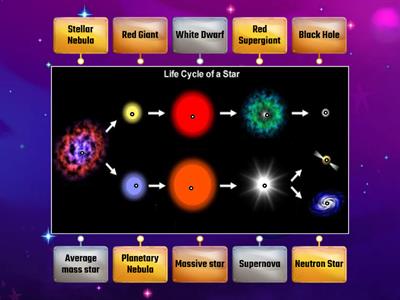
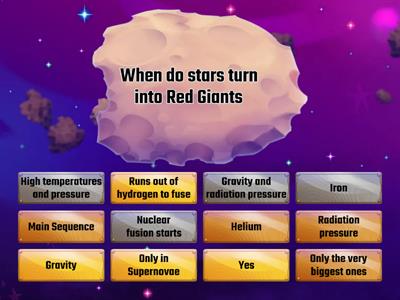
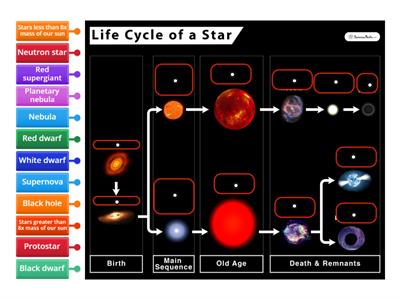
True Statements, A star’s entire life cycle at every stage is controlled by two counteracting forces: inward gravity and outward balancing pressure., Cold, dense interstellar molecular clouds filled with cosmic gas and dust are the birthplace of all newly forming stars., Hydrogen gas, helium gas, and tiny microscopic cosmic dust particles make up the main composition of molecular clouds., Shockwaves produced by nearby exploding stars break the stable state of molecular clouds and make dense clumps collapse under gravity., Thick compact clumps created from collapsing molecular cloud matter develop into protostar objects first., A protostar’s core must hit around ten million Kelvin to start hydrogen fusion ignition at its center., A protostar officially becomes a main sequence star when steady hydrogen fusion begins running inside its core., The main sequence phase is the longest and most stable life stage that any star will go through., Hydrostatic equilibrium inside stars balances inward gravitational pull against two outward forces: thermal pressure and radiation pressure., A star’s time as a stable main sequence body ends when its central core runs completely out of hydrogen fuel., A star’s starting total mass at the beginning of its main sequence stage decides all its later evolutionary steps once core hydrogen runs out., Stars cannot form in empty interstellar vacuums because nuclear fusion reactions cannot take place within undisturbed void space., New stars do not form within white dwarf atmospheres or the leftover clouds from supernova explosions., Simply letting cloud particles slowly cool does not create enough disruption to trigger gravitational collapse of a molecular cloud., Constant hydrostatic equilibrium balance lets main sequence stars hold a consistent size and brightness level over time., Compared to a star’s initial mass, rotation speed, surface temperature, and convection cell count only have minor effects on late stellar evolution., Sustained hydrogen core fusion marks the transition point from a developing protostar to a fully functional main sequence star., Gravitational collapse of molecular cloud clumps is initiated by shockwaves from neighboring stellar explosions, not slow cooling processes., Hydrostatic equilibrium relies on thermal and radiation pressure pushing outward to counteract the inward pull of stellar gravity., After a star’s core hydrogen fuel is fully used up, its initial mass sets the entire path of its remaining life stages., False Statements, A single outward force of gravity alone controls every stage of a star’s full life cycle., New stars form inside hot, empty interstellar vacuum regions with no gas or dust material present., Molecular clouds are mostly made of heavy metal gases and large rock fragments instead of hydrogen, helium, and fine dust., Gentle cooling of cloud particles creates shockwaves that break molecular cloud stability and trigger gravitational collapse., Protostars are the final stage of stellar evolution, forming long after a star leaves the main sequence phase., Hydrogen fusion ignites inside a protostar’s core once core temperatures only reach a few thousand Kelvin., A protostar becomes a main sequence star as soon as it finishes fully collapsing, before any core fusion begins., The red giant phase is the longest and most stable lifespan stage for all stars across the universe., Hydrostatic equilibrium balances outward gravity against a single inward thermal pressure force inside stars., A star’s main sequence stable lifespan ends once its outer atmosphere loses hydrogen fuel, not its central core., A star’s surface temperature and rotation speed fully determine its late evolution path, with initial mass having almost no impact., Nuclear fusion easily occurs inside empty interstellar vacuums, so stars commonly form within total void spaces., White dwarf atmospheres and supernova remnant clouds are the primary environments where brand-new stars form., Slow cooling of molecular cloud particles creates enough disruption to start immediate gravitational collapse of cloud clumps., Main sequence stars constantly shift in size and luminosity because they lack permanent hydrostatic equilibrium balance., A star’s initial mass has a stronger secondary impact than rotation speed and surface temperature on its late-stage evolution., Shockwaves from quiet, stable main sequence stars trigger molecular cloud collapse to form new protostars., Hydrostatic equilibrium only uses thermal pressure to counteract gravity, with radiation pressure playing no balancing role., A star’s core helium depletion is the event that ends its stable main sequence lifetime., Dense molecular cloud clumps first develop into fully formed main sequence stars without passing through a protostar stage.
0%
Stellar Evolution
Bendrinti
Bendrinti
prie
Drkirillsadikov
Redaguoti turinį
Išsaugoti
Patinka
Spausdinti
Įterpti
Daugiau
Užduotis
Lyderių lentelė
Rodyti daugiau
Rodyti mažiau
Ši lyderių lentelė šiuo metu yra privati. Spustelėkite
Bendrinti
, kad ji būtų vieša.
Ši lyderių lentelė buvo išjungta išteklių savininko.
Ši lyderių lentelė yra išjungta, nes jūsų parinktys skiriasi nuo nustatytų išteklių savininko.
Grąžinti parinktis
Teisingai arba neteisingai
yra neterminuotas šablonas. Jis negeneruoja rezultatų lyedrių lentelei.
Reikia prisijungti
Vizualinis stilius
Šriftai
Būtina prenumerata
Parinktys
Labiau taip.
GC_States of matter 1
prie
Pnjeco
Priskyrimas grupėms
10
Solid Matter
prie
Alunas
Pataikyk į kurmį
4
Life Cycle of a Star
prie
Harden1
Diagrama su kortelėmis
24
Life Cycle of Star Processes
prie
Elizabeth312
Rasti tinkamą
5
States of matter True or false
prie
Elizabeth312
Teisingai arba neteisingai
24
Solar system - True or false
prie
Redbusteachers
Teisingai arba neteisingai
6
Properties of Stars
prie
Pricerebecca
Rask tinkamą
3
(Year 10) Life cycle of a star
prie
Gomeschool
Diagrama su kortelėmis
3
Patobulintas dirbtinis intelektas: šioje veikloje yra dirbtinio intelekto sugeneruoto turinio.
Sužinoti daugiau, sužinok daugiau.
Pakeisti šabloną
Rodyti viską
Atviri rezultatai
Kopijuoti nuorodą
QR kodas
Naikinti
Atkurti automatiškai įrašytą:
?