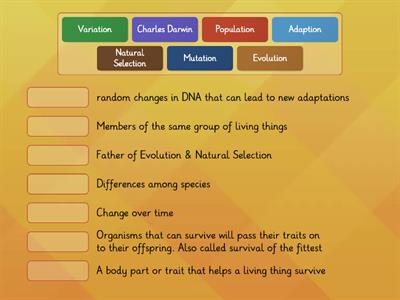
True, Natural selection is the process by which individuals better adapted to their environment are more likely to survive and reproduce., Overproduction means species produce more offspring than can survive., Variation refers to differences in traits among members of a population., Competition occurs because resources such as food, water, and shelter are limited., Helpful hereditary traits can increase in a population over generations., Mutations are changes in genetic material., Only mutations in reproductive cells can be inherited., Natural selection acts only on traits controlled by genes., Environmental changes can influence which traits are helpful for survival., Gregor Mendel showed that parents pass genes to their offspring., Epigenetics studies chemical changes that turn genes on or off without changing the DNA sequence., Individuals with helpful adaptations are more likely to reproduce., Alfred Russel Wallace independently developed the idea of natural selection., Gene expression determines how a cell functions., Over many generations, favorable traits may accumulate in a population., False, Natural selection allows all offspring in a population to survive., Competition occurs because resources are unlimited., Mutations in body cells are passed to offspring., Individuals change their genes during their lifetime in order to survive., Artificial selection and natural selection are exactly the same process., Natural selection creates traits because organisms need them., Overproduction decreases competition among organisms., Environmental changes have no effect on survival., All mutations are harmful to organisms., Natural selection causes immediate change within a single generation.
0%
Natural Selection
Share
Share
by
Adelguirguis68
SAVAAS - Gr 8
Edit Content
Save
Like
Print
Embed
More
Assignments
Leaderboard
Show more
Show less
This leaderboard is currently private. Click
Share
to make it public.
This leaderboard has been disabled by the resource owner.
This leaderboard is disabled as your options are different to the resource owner.
Revert Options
True or false
is an open-ended template. It does not generate scores for a leaderboard.
Log in required
Visual style
Fonts
Subscription required
Options
More like this
natural selection, mutations and extinction
by Anonymous
Find the match
2
Evolution & Natural Selection
by
Msondrusbiology
Match up
36
Natural Selection and Evolution
by
Hkinslow
Match up
18
Natural Selection and Selective Breeding
by
Brittney7
Quiz
3
Natural Selection
by
Dawargo
Match up
17
Natural selection, mutations and extinction
by
Andrewhartley
Find the match
2
Natural Selection, Genetics, & Heredity
by
Hollandshon
Unjumble
2
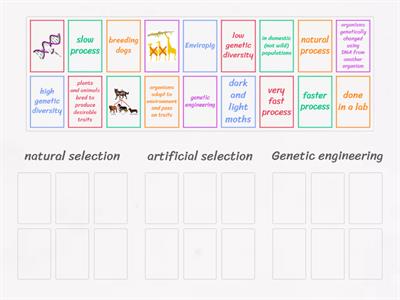
Natural selection, artificial selection, and genetic engineering
by
Caramjorden
Group sort
3
Switch template
Show all
Open results
Copy link
QR code
Delete
Continue editing:
?