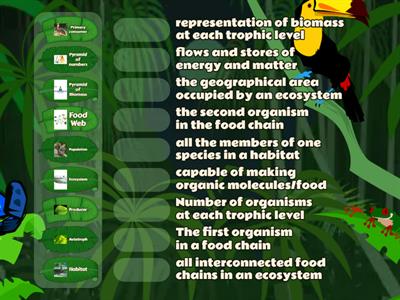
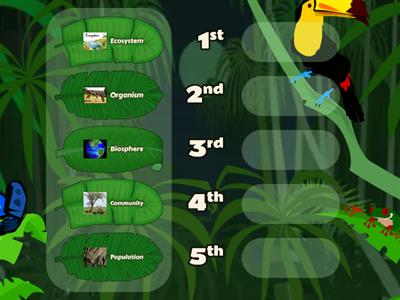
Microbial ecology, The study of the interrelationships of microorganisms in their natural environment, Guilds, Populations of microorganisms that perform linked metabolic activities, Communities, Sets of guilds, are usually heterogeneous, exceptions exist in extreme environments, Microhabitats, Small niches where populations and guilds reside because of optimal conditions, Habitats, Physical locations where organisms are found, made of microorganisms, Ecosystems, Organisms, their abiotic environment, and the relationship between the two, Biodiversity, The number of species in a given ecosystem, Biomass, The quantity of all organisms in an ecosystem, Biogeochemical cycle, A circuit or pathway through which organic compounds or a chemical element is changed from one state to another through different parts of an ecosystem, Biotic, Living parts of an ecosystem (animals, plants, microbes, etc), Abiotic, Non-living parts of an ecosystem (rocks, water, atmosphere, etc), Biogeochemistry, The study of chemical transformation through these cycles, Primary biogeochemical cycle, The carbon cycle, Nitrogen fixation, nitrogen gas is reduced to ammonia by the enzyme nitrogenase, only a small number of prokaryotes can do this, Littoral zone, area along the shoreline with lots of rooted vegetation and good light, nutrients enter here, most abundant and diverse life, Limnetic zone, well-lit, upper layer of water away from the shore, occupied by phytoplankton like algae, cyanobacteria, and zooplankton, etc, Profundal zone, deeper water below the limnetic- low light, low O2, Benthic zone, sediments at the bottom of a lake, contains benthos (bottom-dwelling organisms), low temps and low O2 levels, Abyssal zone, Deep ocean trenches, Bioterrorism, Using biological agents to incapacitate or kill civilians or military personnel during a terrorist attack or war
0%
Chapter 23
Share
Share
by
Alexandrianeff7
Edit Content
Save
Like
Print
Embed
More
Assignments
Leaderboard
Show more
Show less
This leaderboard is currently private. Click
Share
to make it public.
This leaderboard has been disabled by the resource owner.
This leaderboard is disabled as your options are different to the resource owner.
Revert Options
Find the match
is an open-ended template. It does not generate scores for a leaderboard.
Log in required
Visual style
Fonts
Subscription required
Options
More like this
Ecosystem Key Terms
by
Mvanston
Match up
6
Ecosystems - Terrestrial
by
Kellmelle
Group sort
28
Ecosystem Vocabulary
by
Kathryn18
Match up
21
Levels of Ecosystem
by
Cformento
Rank order
10
Ecosystem Vocabulary
by
Juliajulian
Maze chase
16
FORM 2 SCIENCE CHAPTER 2 ECOSYSTEM
by
Stemvibes4
Labelled diagram
5
Higher level ecology terms
by
Marylouise
Match up
7
National 5 Biology Ecosystem terms
by
9089555
Match up
7
Switch template
Show all
Open results
Copy link
QR code
Delete
Continue editing:
?