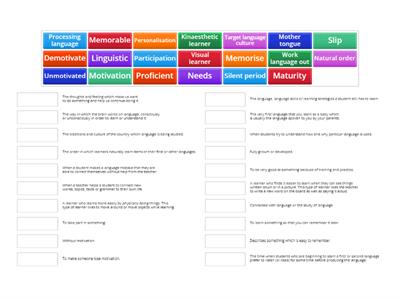
According to Stephen Krashen, which statement best describes the Affective Filter Hypothesis?, To maximize language learning, students should learn in a low-stress environment where anxiety is minimized, Language learning comes from having access to comprehensible input, Language learning happens best through the application of effective operant conditioning, If cultural groups have a positive attitude towards one another, there is a greater chance for language learning them, Why do traditional language learning methods often have a high failure rate?, We now know more about how the brain works, They focus on individuals rather than broader social contexts, They rely on outdated practices such as positive and negative reinforcement, which are not effective for language acquisition, They focus mainly on speaking and listening, neglecting reading and writing, Which is not an example of factors that relate to language acquisition? (Krashen), Motivation, Self esteem, Anxiety, Age, Which scenario best describes the Zone of Proximal Development (Lev Vygotsky)?, A student is able to complete their work independently with some errors, A student successfully completes a task with support from their teacher, A student refuses to work even though they are capable of completing it, A student is given work that is too difficult to complete, even with support, What stage of language acquisition is an ELL at if they have developing comprehension, produce simple sentences, make grammatical errors, and may misunderstand jokes or idioms?, Intermediate Fluency, Early Production, Noob Stage, Speech Emergence, According to Stephen Krashen, which approach is not helpful when supporting ELLs in the classroom?, Require students to speak frequently in front of peers during early language development, Encourage students to draw pictures while reading, Create a learning environment that is engaging and rich in language, Give students adequate time and space to process and respond, Which best describes Cognitive Academic Language Proficiency (CALP)?, Everyday conversational language that is used in social interactions, Language used in academic settings with complex vocabulary and structure, Nonverbal communication accomplished through gestures and visuals, Basic vocabulary learned through repetition, How long does it typically take an English language learner to reach advanced fluency?, 1-2 years, 3-4 years, 5-7 years, 8-9 years, What is a key difference between first-language acquisition and second-language acquisition?, Second-language learners do not rely on listening, First-language acquisition does not involve speaking, First-language acquisition requires formal instruction, Second-language acquisition assumes knowledge of a first language, Why might a student appear fluent in English but still struggle academically?, They lack motivation, Social language develops faster than academic language, They have not learned basic vocabulary, They are in the silent period, Which strategy is most effective for supporting English Language Learners (ELLs) during instruction?, Limit student interaction until they are fully fluent, Focus mainly on written grammar drills before speaking activities, Correct every grammar mistake immediately to prevent errors, Use visuals, gestures, and modeling to support understanding of new language
0%
Module 4: Culminating Task - Recognizing Second Language Learning - Steph April
Share
Share
by
Sapril1
Edit Content
Save
Like
Print
Embed
More
Assignments
Leaderboard
Show more
Show less
This leaderboard is currently private. Click
Share
to make it public.
This leaderboard has been disabled by the resource owner.
This leaderboard is disabled as your options are different to the resource owner.
Revert Options
Quiz
is an open-ended template. It does not generate scores for a leaderboard.
Log in required
Visual style
Fonts
Subscription required
Options
More like this
Mastering languages outcomes
by
Annalele
Quiz
40
The language of learning
by
Whereisfionaj
Match up
4
Hypotheses of Krashen's Theory of Second Language Acquisition
by
Aramoixunife
Crossword
6
Language Learning Discussion
by
Nijomakh
Spin the wheel
4
TKT Module 1 Background to language learning (1)
by
Katherinesha
Match up
6
TKT Module 1 Background to language learning (2)
by
Katherinesha
Match up
8
Learning languages questions
by
Olgavanina92
Spin the wheel
5
Language Learning Discussion Questions
by
Puzyrevasn
Speaking cards
8
Switch template
Show all
Open results
Copy link
QR code
Delete
Continue editing:
?