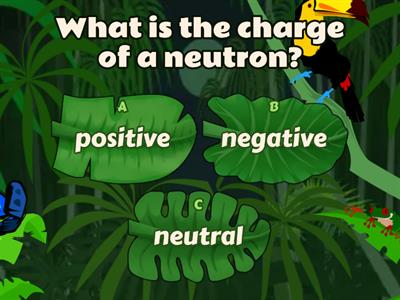
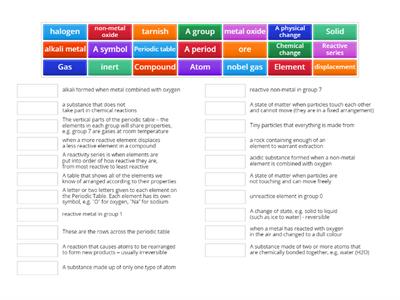
periodic table (n.), A chart that organizes chemical elements by their atomic numbers and properties., chemical element (n.), A pure substance made of only one kind of atom., atom (n.), The smallest unit of an element that keeps its chemical properties., nucleus (n.), The central part of an atom that contains protons and neutrons., proton (n.), A positively charged particle found in the nucleus., neutron (n.), A particle in the nucleus that has no electric charge., electron (n.), A negatively charged particle that moves around the nucleus., atomic number (n.), The number of protons in an atom., atomic mass (n.), The average mass of an element's atoms., atomic mass unit (n.), A unit used to measure the mass of atoms., chemical symbol (n.), A short form used to represent an element., electron shell (n.), A region around the nucleus where electrons are located., electron configuration (n.), The arrangement of electrons in an atom., valence electron (n.), An electron in the outermost shell of an atom., period (n.), A horizontal row in the periodic table., group (n.), A vertical column in the periodic table., Group A (n.), The traditional name for the main-group elements., Group B (n.), The traditional name for transition elements., block (n.), A section of the table based on electron configurations., s-block (n.), The block containing elements with outer electrons in s orbitals., p-block (n.), The block containing elements with outer electrons in p orbitals., d-block (n.), The block containing transition metals., f-block (n.), The block containing lanthanides and actinides., metal (n.), An element that usually conducts heat and electricity well., non-metal (n.), An element that lacks typical metallic properties., noble gas (n.), A very stable gas in Group 18 of the periodic table., chemical property (n.), A feature that describes how a substance reacts chemically., nuclear charge (n.), The positive charge of an atom's nucleus., discovery (n.), The act of finding something previously unknown., predict (v.), To state that something is likely to happen in the future.
0%
periodic table
Share
Share
by
Chem20262027
Edit Content
Save
Like
Print
Embed
More
Assignments
Leaderboard
Show more
Show less
This leaderboard is currently private. Click
Share
to make it public.
This leaderboard has been disabled by the resource owner.
This leaderboard is disabled as your options are different to the resource owner.
Revert Options
Match up
is an open-ended template. It does not generate scores for a leaderboard.
Log in required
Visual style
Fonts
Subscription required
Options
More like this
Periodic Table
by
Dochapa
Maze chase
57
Properties of the Periodic Table
by
Swright
Match up
6
Periodic Table
by
Sci3
Gameshow quiz
6
Elements and Periodic table
by
Emmafarrell1120
Match up
9
Elements of the Periodic Table
by
Kwarren13
Wordsearch
3
Periodic Table
by
Chellewalker26
Gameshow quiz
21
Atom & Periodic table review
by
Difabiocms
Quiz
14
Periodic table keywords
by
Swright
Match up
4
Switch template
Show all
Open results
Copy link
QR code
Delete
Continue editing:
?