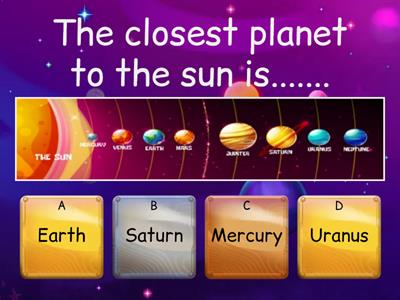
Plants produce their own food through photosynthesis using sunlight, water, and:, Hydrogen, Nitrogen, Oxygen, Carbon dioxide, The removal of metabolic waste products from a living body is known as:, Excretion, Digestion, Transpiration, Respiration, Stomata are tiny pores located on leaves that facilitate:, Water absorption from soil, Gas exchange during respiration and photosynthesis, Protection against insects, Seed dispersal, Plants like Mimosa pudica (Touch-Me-Not) fold their leaves when touched. This displays:, Growth towards light, Excretion, Response to touch stimulus, Locomotion, Earthworms breathe through their:, Lungs, Trachea, Moist skin, Gills, Which planet is the largest in our solar system?, Saturn, Jupiter, Uranus, Neptune, Mars is known as the Red Planet because its surface contains:, Frozen gases, Red sand dunes, Active volcanoes, Iron oxide (rust), Why is Venus hotter than Mercury despite being further from the Sun?, Thick carbon dioxide atmosphere traps heat, Its surface is made of lava, It has more volcanoes, It is closer to Earth, Which celestial body is a natural satellite orbiting the Earth?, Venus, Polaris, Sun, Moon, Recognizable patterns formed by groups of stars in the night sky are called:, Asteroids, Comets, Constellations, Galaxies, The Pole Star (Polaris) is a part of which constellation?, Orion, Ursa Minor, Cassiopeia, Ursa Major, What is the brightest star visible in the night sky?, Sirius, Betelgeuse, Polaris, Alpha Centauri, Our solar system belongs to which galaxy?, Andromeda, Milky Way, Triangulum, Sombrero, Planetary bodies that orbit stars directly are known as:, Natural satellites, Meteors, Planets, Comets, The distance food travels from where it is grown to where it is consumed is called:, Food Miles, Transport miles, Crop distance, Supply length, Which planet is closest to the Sun?, Venus, Mars, Earth, Mercury, Rocky bodies that orbit the Sun, mostly located between Mars and Jupiter, are called:, Satellites, Asteroids, Meteorites, Comets, Glowing balls of ice, dust, and rock that form long tail-like structures near the Sun are:, Asteroids, Meteors, Planets, Comets, The movement of Earth on its own axis causing day and night is called:, Rotation, Precession, Inclination, Revolution, The Earth completes one full revolution around the Sun in approximately:, 12 months, 28 days, 365.25 days, 24 hours
0%
3Final
Share
Share
by
Priyajainfmh
Edit Content
Save
Like
Print
Embed
More
Assignments
Leaderboard
Show more
Show less
This leaderboard is currently private. Click
Share
to make it public.
This leaderboard has been disabled by the resource owner.
This leaderboard is disabled as your options are different to the resource owner.
Revert Options
Quiz
is an open-ended template. It does not generate scores for a leaderboard.
Log in required
Visual style
Fonts
Subscription required
Options
More like this
Planets quiz
by
Anagulevych
Gameshow quiz
6
The planets
by
Annagilgunn123
Wordsearch
6
PLANETS QUIZ
by
Maniya2011
Quiz
5
Earth's Seasons
by
Choosescience
Labelled diagram
7
Planets Quiz
by
Lkt112893
Gameshow quiz
8
Planets' facts
by
Maviebien
Quiz
5
The planets
by
Cp51
Whack-a-mole
3
Planets (quiz)
by
Liannewalley
Quiz
21
AI Enhanced: This activity contains content generated by AI.
Learn more.
Switch template
Show all
Open results
Copy link
QR code
Delete
Continue editing:
?