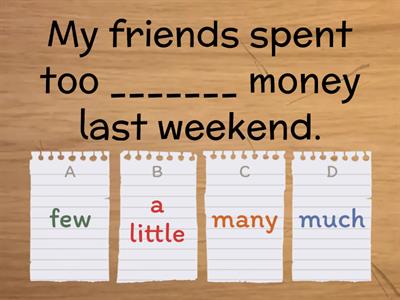
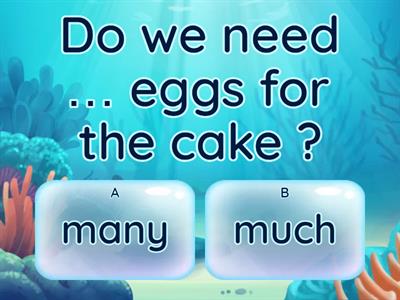
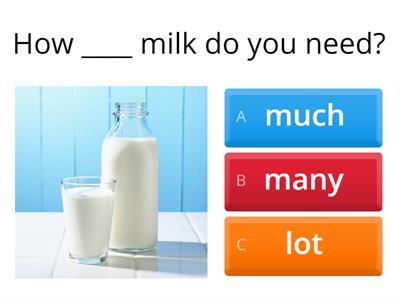
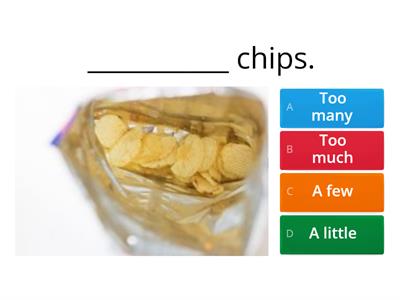
MUCH 💡 Use: a large quantity of something uncountable. Do not use in affirmatives. 📌Example: I don't have much time.🧠 Remember: MUCH → things you can’t count individually., MANY 💡 Use: a large number of countable things. 📌 Example: I don't have many books. 🧠 Remember: MANY → things you can count individually., TOO MUCH 💡 Use: more of something uncountable than is necessary or desirable. 📌 Example: There is too much sugar in this coffee. 🧠 Remember: TOO MUCH → more than is good or necessary + uncountable., TOO MANY 💡 Use: more countable things than is necessary or desirable. 📌 Example: There are too many people here. 🧠 Remember: TOO MANY → more than is good or necessary + countable., FEW 💡 Use: a small number of countable things, suggesting almost none or not enough. 📌 Example: Only few people came to the meeting. 🧠 Remember: FEW → almost none / not enough., A FEW 💡 Use: a small number of countable things, suggesting some. 📌 Example: I have a few friends in London. 🧠 Remember: A FEW → some, not none., LITTLE 💡 Use: a small amount of something uncountable, suggesting almost none or not enough. 📌 Example: There is little hope of finding him. 🧠 Remember: LITTLE → almost none / not enough., A LITTLE 💡 Use: a small amount of something uncountable, suggesting some. 📌 Example: I have a little time before the meeting. 🧠 Remember: A LITTLE → some, not none., A LOT OF / LOTS OF 💡 Use: a large quantity or number of something. 📌 Example: We have lots of time. 🧠 Remember: A LOT OF / LOTS OF → works with countable and uncountable nouns., HARDLY ANY 💡 Use: almost none or almost not any. 📌 Example: There is hardly any milk left. 🧠 Remember: HARDLY ANY → almost zero; works with countable and uncountable nouns., A FEW 💡 Use: a small number of countable things. 📌 Example: I need a few minutes. 🧠 Remember: A FEW → things you can count., A BIT OF / A LITTLE 💡 Use: a small amount of something uncountable. 📌 Example: Add a bit of salt. 🧠 Remember: A LITTLE / A BIT OF → things you can’t count individually., ENOUGH 💡 Use: as much or as many as necessary; a sufficient quantity. 📌 Example: We have enough food for everyone. 🧠 Remember: ENOUGH → the right amount / sufficient. Works for countable and uncountable., NOT ENOUGH 💡 Use: less than the quantity necessary; an insufficient quantity. 📌 Example: We don't have enough food for everyone. 🧠 Remember: NOT ENOUGH → less than necessary / insufficient. Works for countable and uncountable., PLENTY OF 💡 Use: a large quantity or number; more than enough. 📌 Example: There are plenty of restaurants nearby. 🧠 Remember: PLENTY OF → more than enough; works with countable and uncountable nouns., NO 💡 Use: zero quantity or number; not any. 📌 Example: We have no time. 🧠 Remember: NO → zero; works with countable and uncountable nouns., A LARGE NUMBER 💡 Use: a large quantity of countable things. 📌 Example: A large number of students attended the event. . 🧠 Remember: A LARGE NUMBER → countable nouns., A LARGE AMOUNT 💡 Use: a large quantity of something uncountable. 📌 Example: A large amount of money was spent. 🧠 Remember: A LARGE AMOUNT → uncountable nouns.
0%
Quantifiers (B1)
Share
Share
by
Jesycarreira
Edit Content
Save
Like
Print
Embed
More
Assignments
Leaderboard
Show more
Show less
This leaderboard is currently private. Click
Share
to make it public.
This leaderboard has been disabled by the resource owner.
This leaderboard is disabled as your options are different to the resource owner.
Revert Options
Flash cards
is an open-ended template. It does not generate scores for a leaderboard.
Log in required
Visual style
Fonts
Subscription required
Options
More like this
Quantifiers (much/many/any/some/few/a little)
by
Alinchikkazmenk
Quiz
81
Quantifiers (a lot of / much / many / a little / a few)
by
Blumarino
Quiz
37
Quantifiers (a little, little, few, a few, too much, too many, lots of, any, some)
by
Ksuhababiy
Quiz
69
Quantifiers: much/many/a lot of/a few/ a little
by
Hiccup
Quiz
24
Much, many, a few, a little, some, any, too much, plenty of, enough
by
Champloo
Quiz
14
Quantifiers - Too many/much; A few/little; Enough/not enough
by
Teacherjoe1
Quiz
10
Quantifiers - some, any, a few, a little, much, many, a lot of
by
Cselko
Quiz
12
Quantifiers - some, any, a few, a little, a lot of, much, many
by
Anbassiab1
Quiz
12
Switch template
Show all
Open results
Copy link
QR code
Delete
Continue editing:
?