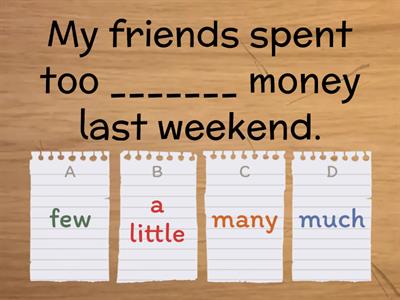
The magician held a twenty-euro note in __________ hand., each, every, all, __________ guests came to the reception because of the storm, so the venue looked almost empty., A few, Very few, Plenty of, When referring to a group as a whole, use every; but use each when thinking of members as __________., individuals, total, a couple, Modern usage permits either a singular or plural verb after none of; for example, None of the students __________ the exam., only passes, has/have passed, having passed, It is __________ cold outside, so make sure to wear a thick winter coat., totally, absolutely, bitterly, Her research on renewable energy is __________ known throughout the scientific community., deeply, utterly, widely, The child was __________ shy and found it hard to make friends at school., painfully, completely, perfectly, Expecting us to work overnight without pay is __________ unacceptable., deeply, totally, highly, Don't worry about riding the roller coaster; it is __________ safe., heavily, bitterly, perfectly, With gradable adjectives, quite means "fairly"; but with ungradable adjectives like impossible, quite means __________., relatively, completely, slightly, The two brothers have __________ different personalities despite being twins., completely, highly, heavily, There are __________ apples in the basket, so we need to buy more., few, a few, every, any, __________ of the water was spilled on the floor., Each, Many, Few, Some, She has visited __________ countries in Europe during the last year., much, little, several, every, We have __________ time left, so let's hurry., a little, little, many, several
0%
Quantifiers & Adverb + Adjective Collocations
Share
Share
by
Lmendoza31
Edit Content
Save
Like
Print
Embed
More
Assignments
Leaderboard
Show more
Show less
This leaderboard is currently private. Click
Share
to make it public.
This leaderboard has been disabled by the resource owner.
This leaderboard is disabled as your options are different to the resource owner.
Revert Options
Quiz
is an open-ended template. It does not generate scores for a leaderboard.
Log in required
Visual style
Fonts
Subscription required
Options
More like this
Quantifiers (a little, many, much, a few)
by
Mrhman2016
True or false
9
Quantifiers (much/many/any/some/few/a little)
by
Alinchikkazmenk
Quiz
81
Quantifiers: a lot of, some, a few, a little & any.
by
Sbfifthformd
Gameshow quiz
8
Quantifiers (a little, little, few, a few, too much, too many, lots of, any, some)
by
Ksuhababiy
Quiz
69
Quantifiers: much/many/a lot of/a few/ a little
by
Hiccup
Quiz
24
MUCH/MANY/FEW/LITTLE
by
Aslihanariciogl
Quiz
9
Quantifiers - some, any, a few, a little, much, many, a lot of
by
Cselko
Quiz
12
Quantifiers - some, any, a few, a little, a lot of, much, many
by
Anbassiab1
Quiz
12
AI Enhanced: This activity contains content generated by AI.
Learn more.
Switch template
Show all
Open results
Copy link
QR code
Delete
Continue editing:
?