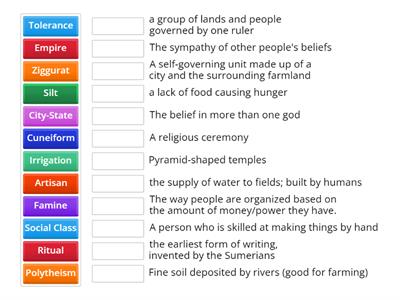
Fertile Crescent, a boomerang-shaped region in the Middle East, civilization began here, Mesopotamia, land between two rivers, between the Tigris and Euphrates Rivers., Silt, fine soil deposited, left behind by flood waters., Fertile, good for growing crops, healthy soil to produce (grow) food., Polytheism, the belief in more than one god or spiritual being, many gods, Irrigate, supplying water to land and crops using channels and canals., Ziggurat, massive, pyramid-like, stacked structures with flat tops, a temple to the gods, Cuneiform, writing that used pictographs and wedge-shaped symbols to keep records, Monarchy, rule by a monarch; a king, Hammurabi’s Code, a set of 282 written laws and punishments created by King Hammurabi, Justice, having fair laws that hold people accountable for their actions., Barter, trading items or services directly without using money., Imports, goods or items brought IN., Exports, goods or items sent out-EXIT., Surplus, having more than you need, extra., Reliable, a term for dependable, consistent, trustworthy, Annual, a term to describe once a year, Hammurabi, became king at age 18 and ruled for 43 years., Wheel, improved trade, making moving long distances possible, 60, used to measure time and create a 12 month calendar., Seed Funnel, improved farming making planting faster and easier., Orderly, Hammurabi hoped to keep his empire safe and?, Priests, connected to the gods and chose leaders to rule the city., 282, number of written laws in Hammurabi's Code., Slaves, this group of people were at the bottom of the social class pyramid., Kings, Protected the city, built temples, and were at the top of the social class pyramid.
0%
Mesopotamia
Share
Share
by
Tfoster6
Edit Content
Save
Like
Print
Embed
More
Assignments
Leaderboard
Show more
Show less
This leaderboard is currently private. Click
Share
to make it public.
This leaderboard has been disabled by the resource owner.
This leaderboard is disabled as your options are different to the resource owner.
Revert Options
Match up
is an open-ended template. It does not generate scores for a leaderboard.
Log in required
Visual style
Fonts
Subscription required
Options
More like this
Mesopotamia
by
Lorenzo2
Whack-a-mole
8
Mesopotamia Vocabulary
by
Msnyw2020
Match up
6
Mesopotamia Revision
by
Inessayar
Gameshow quiz
3
Mesopotamia Vocabulary MQ2020
by
Mquinn2
Match up
3
Mesopotamia Knowledge Domain 4
by
Nrussell
Matching pairs
7
Mesopotamia & Indus River Vocabulary
by
Sballantyne
Match up
4
Mesopotamia
by
Zhangrac
Match up
10
Ancient Mesopotamia Vocabulary
by
Andrewcsisson
Match up
2
Switch template
Show all
Open results
Copy link
QR code
Delete
Continue editing:
?