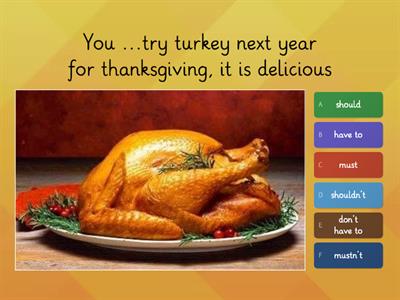
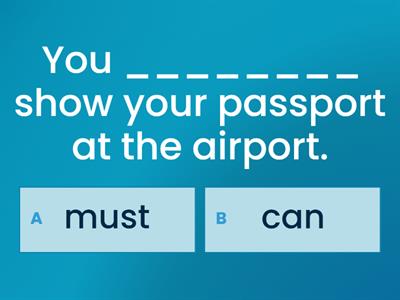
What do modal verbs usually show?, They help form different verb tenses., They show ability, possibility, permission, or advice., They always change their form for the 3rd person singular., They show main actions in a sentence., Which statement is true about modal verbs?, They add '-s' for 'he', 'she', 'it'., They can be used alone, without another verb., They form questions and negatives with 'do'., They are always followed by the base form of another verb., What is the main difference between a modal verb and an auxiliary verb?, Auxiliaries are more formal, modals are informal., Modals always have a clear subject, auxiliaries do not., Auxiliaries are followed by any verb form, but modals only by infinitives., Modals show meaning (e.g. possibility) , auxiliary help make tenses., Which of these are examples of modal verbs?, 'Can', 'Might', 'Should', 'Is', 'Are', 'Was', 'Run', 'Eat', 'Sleep', 'Go', 'Do', 'Have', What are the three main auxiliary verbs?, 'Walk', 'Talk', 'Sing', 'Often', 'Never', 'Always', 'Do', 'Be', 'Have', 'Must', 'May', 'Could', In the sentence 'It could rain tomorrow.', what is the modal verb?, Tomorrow, Is, Rain, Could, In the sentence 'She has done her homework.', what is the auxiliary verb?, Has, Have, Homework, Done, Choose the correct modal verb to complete the sentence: 'You ______ go to the dentist for a regular check-up.', Must, Will, Would, Can, Choose the correct auxiliary verb to complete the sentence: 'They ______ studying for their exam right now', Have, Are, Did, Will, In the sentence 'You should have been more careful.', identify the modal verb and the auxiliary verb., 'Be' (auxiliary), 'careful' (modal), 'Should' (modal), 'have' (auxiliary), 'More' (modal), 'you' (auxiliary), 'Should' (modal), 'been' (auxiliary)
0%
Modal verbs
Share
Share
by
Sarafontao
Superior
Universidad
Adultos
Inglés
Edit Content
Save
Like
Print
Embed
More
Assignments
Leaderboard
Show more
Show less
This leaderboard is currently private. Click
Share
to make it public.
This leaderboard has been disabled by the resource owner.
This leaderboard is disabled as your options are different to the resource owner.
Revert Options
Quiz
is an open-ended template. It does not generate scores for a leaderboard.
Log in required
Visual style
Fonts
Subscription required
Options
More like this
MODAL VERBS quiz
by
Treupaloma
Quiz
3
MODAL VERBS
by
Paularecabalher
Quiz
5
Modal Verbs [can, must, should, may]
by
Streletcaia
Quiz
5
MODAL VERBS (MUST, SHOULD, COULD, MIGHT, MAY)
by
Mselizabethbarr
Quiz
5
Modal Verbs (Can, Must, Should) - Quiz
by
Susekovata
Quiz
4
Conversation Questions: Modal verbs
by
Mferlopz
Speaking cards
11
Modals (Can, Could, May, Must, Should)
by
Mkurkova1
Complete the sentence
8
Modal verbs - Must / Should / Can
by
Msalegonzales
Quiz
4
Switch template
Show all
Open results
Copy link
QR code
Delete
Continue editing:
?