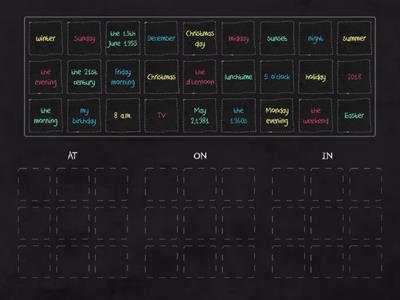
So we'll see you on Friday. / So we'll see you Friday., Both are possible. The second one is more common for American English., Are you going anywhere on Christmas? / Are you going anywhere at Christmas?, At Christmas - is correct.You can also say ‘on Christmas Day’., I’ll talk to you later. / I’ll talk with you later., I’ll talk to you later - is correct., After attending the meeting, I went to meet Paul. / After, I went to meet Paul., After attending the meeting, I went to meet Paul - is correct. After must be followed by a noun, pronoun or gerund., We’ll have a stand-up meeting in the morning. / We’ll have a stand-up meeting in Monday morning., We’ll have a stand-up meeting in the morning - is correct. You can say ‘on Monday morning’., Did you see the news on TV last night? / Did you see the news on TV the last night?, Did you see the news on TV last night? - is correct., The presentation lasted an hour and a half. / The presentation lasted during an hour and a half., The presentation lasted an hour and a half - is correct., We're going to Australia in August 11th. / We're going to Australia in August., We're going to Australia in August - is correct. We use preposition ‘on’ with dates., What time is the meeting? - At a quarter past nine. / What time is the meeting? - At a quarter after nine., Both are possible. ‘Past’ is mostly British, ‘after’ is mostly American., When did he turn up? - At 11 a.m. o'clock. / When did he turn up? - At 11 o'clock., When did he turn up? - At 11 o'clock - is correct. You can use either ‘a.m./ p.m.’ or ‘o’clock’.
0%
TASK 7a
Share
Share
by
Yappiteachers
Edit Content
Save
Like
Print
Embed
More
Assignments
Leaderboard
Show more
Show less
This leaderboard is currently private. Click
Share
to make it public.
This leaderboard has been disabled by the resource owner.
This leaderboard is disabled as your options are different to the resource owner.
Revert Options
Flash cards
is an open-ended template. It does not generate scores for a leaderboard.
Log in required
Visual style
Fonts
Subscription required
Options
More like this
Prepositions of time Speaking
by
Kseniyacoach
Spin the wheel
53
Prepositions of time - Quiz
by
Pixiepickpocket
Quiz
17
Prepositions of Time Practice
by
Yanapershina
Group sort
7
TELLING THE TIME (o'clock and half past ...)
by
Ikatarina33
Quiz
53
Prepositions of Time activity
by
Adulted
Quiz
8
English File advanced time expressions
by
Aleksandra223
Complete the sentence
6
Days of the week+ Present Simple (HE+Vs)
by
Tetianashchadylo
Complete the sentence
6
present simple with day and time
by
Amalalsalmi1979
Unjumble
7
Switch template
Show all
Open results
Copy link
QR code
Delete
Continue editing:
?